


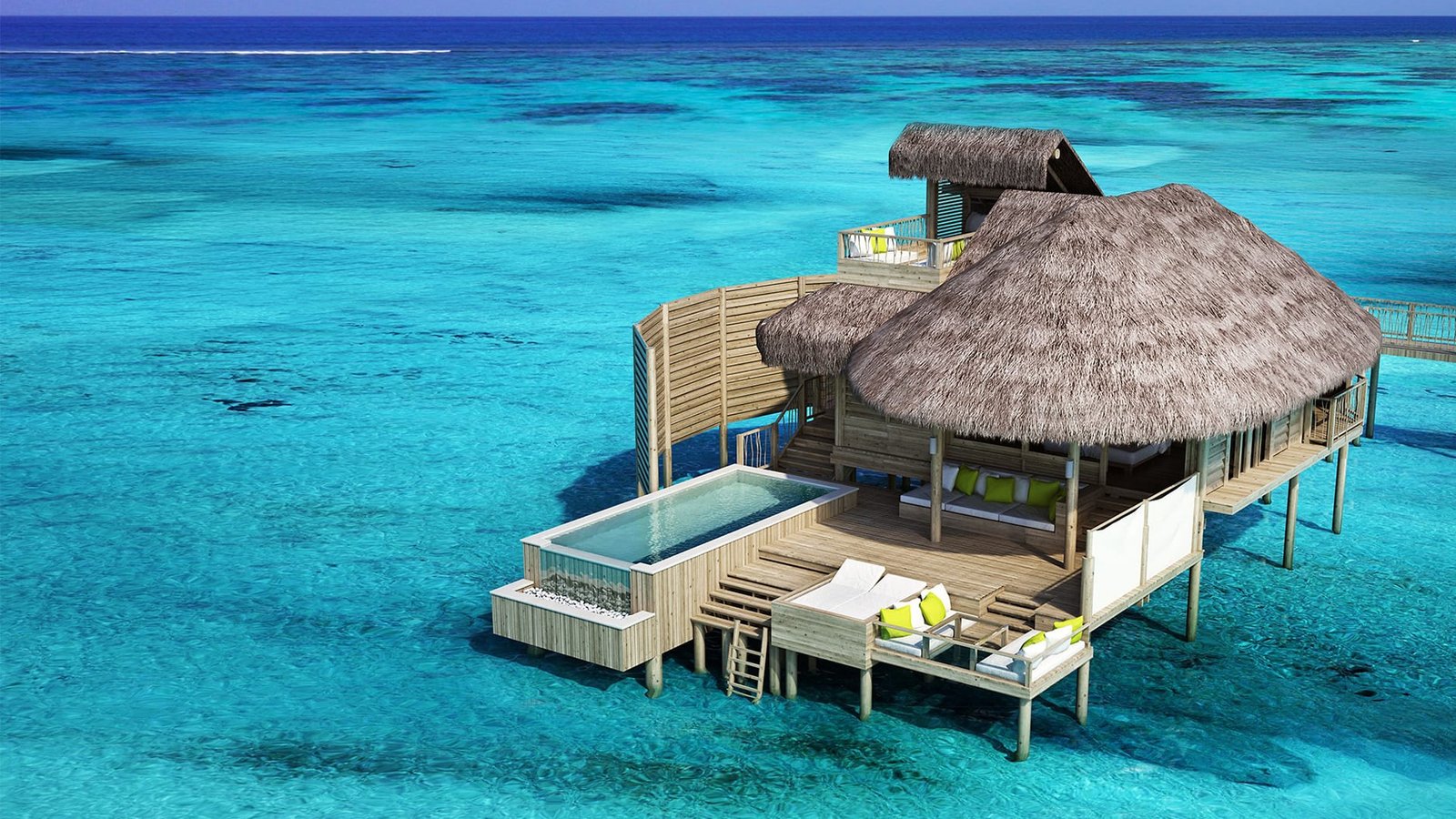
The ladder is the thing nobody photographs. Every overwater villa has one, dropping from the deck into the lagoon, and in the brochure it is a promise. At eleven in the morning in late July, with a metre of chop and the tide out, it is a decision. Most guests use it twice in a week. The couple in the beach villa forty metres away, who paid considerably less, walked into the water from the sand every single day without thinking about it.
The overwater villa versus beach villa question is the most expensive decision in a Maldives booking, and almost every guide answering it is published by a resort selling one or the other. This is an independent comparison, drawn from the three Maldives resorts we have reviewed, covering cost, privacy, heat, families, photographs and the orientation detail that matters more than the category itself.
We should say up front that we are not against overwater villas. They are the reason the Maldives became the Maldives, and for the right trip they are worth every penny of the premium. We are against booking one by default, which is what most people do.
The short answer
Book the overwater villa if: it is a honeymoon or a milestone, you are travelling between December and April, the photographs matter, and you want the specific experience of waking above water. Two people, no children, calm season.
Book the beach villa if: you have children, you are travelling between May and November, you want outdoor space rather than a deck, you burn easily, or you would rather put the difference towards a longer stay or a better resort.
Book a split stay if: you are there for seven nights or more and cannot decide. Three nights beach, four nights overwater is a genuinely good structure, and most resorts will accommodate it.
What you are actually paying for
The premium varies enormously by resort and by season, which is why we are not going to print a single percentage and pretend it is universal. What is consistent is the shape of it: the gap between beach and overwater widens in the dry season and narrows in the green season, because overwater inventory is what sells first when demand is high.
That produces a useful rule. In peak season, the overwater premium is at its most expensive and the sea is at its calmest. In green season, the premium is at its smallest and the sea is at its roughest. The market prices the villa, not the conditions, which means the value case for overwater is strongest in exactly the months when the experience is best. That is unusual and it is worth knowing.
Before you compare any two rates, read our guide to the best time to visit the Maldives, because the month you choose moves the premium more than the resort you choose.
The taxes apply to both, and they are not small
Green Tax is charged per person per night regardless of villa category, currently 12 US dollars at resorts. Tourism GST runs at 17 percent and service charge at 10 percent, and those two apply to the room rate, so they scale with your villa choice. Upgrading from beach to overwater therefore costs more than the headline difference, because roughly 27 percent of the gap follows it.
The case for the overwater villa
Direct lagoon access, when the lagoon cooperates
The steps into the water are the whole proposition, and at a good resort they deliver. Our review of Waldorf Astoria Maldives Ithaafushi, which we scored 9.4, describes 122 villas split between beachfront and overwater, every one with a private pool, sundeck and direct water or beach access. On the overwater side that means steps into the lagoon from your own deck.
The caveat is the house reef. Direct access is only as good as what you can access. Some resorts have a genuine reef within swimming distance of the overwater rows; others have sand and seagrass. Our review of The Ritz-Carlton Maldives, Fari Islands, scored 9.2, is candid that the house reef there is modest, and points guests instead towards the manta cleaning stations north of the atoll by dhoni at first light. That is a better morning than a house-reef snorkel, but it is a boat trip, not a ladder.
Ask before you book: is there a reef within swimming distance of the overwater villas, and at what state of tide?
Privacy from the water side
An overwater row gives you a neighbour on one or both sides and nobody in front. A beach villa gives you a garden wall on both sides and, at many resorts, a beach that anyone can walk along. If uninterrupted privacy in the daytime is the priority, overwater usually wins.
The photograph, which is a legitimate reason
We are not going to be sniffy about this. If you are spending this much once, and the images are part of what you are buying, the overwater villa is the image. Pretending otherwise is dishonest. Just be clear with yourself that it is one of the reasons, so you can weigh it against the others rather than letting it decide alone.
The case for the beach villa
Space, and the kind you can actually use
Beach villas typically come with a garden, an outdoor shower and a sense of ground that a deck over water cannot reproduce. At the Ritz-Carlton, our reviewer noted the beach villas sit in replanted vegetation with direct sand access. That vegetation is the point: it gives shade, texture and a boundary.
Heat and shade, which the brochures never mention
This is the most under-discussed difference and it decides a lot of holidays. An overwater villa is a structure over open water with minimal shade, and the deck gets genuinely hot from late morning onward. There is nowhere to sit outside that is not in full sun unless the villa was designed with a covered section, and many are not.
A beach villa has trees. In April, or in the humid stretch from May to September, that difference is not cosmetic.
Families, where the ladder becomes a problem
Both of the resorts we have reviewed in detail steer families towards beach villas, and they are right to. A villa suspended over water with a ladder, an open deck and a pool is a supervision problem for anyone with a child under about eight. A beach villa with a garden gate and sand is not.
Our reviewer’s note on the Waldorf Astoria was that every category feels indulgent, and that beach villas suit families better. That is the honest framing: you are not downgrading, you are choosing the correct room.
If you are travelling with children, our family collection is a better starting point than any villa comparison.
Cost, and what the saving buys
The most persuasive argument for the beach villa is what you do with the difference. Depending on resort and season, the gap between categories across a week can be enough to fund two extra nights, a materially better resort, or the excursion budget that turns a beach holiday into a trip you talk about afterwards.
Our position, stated plainly: for a seven-night stay, we would take a beach villa at a better resort over an overwater villa at a lesser one, almost every time.
The things nobody tells you
Orientation matters more than category
This is the single most useful thing in this article and it is not about beach versus overwater at all.
Whether your villa faces sunrise or sunset changes your day more than whether it sits on sand or stilts. Sunset-facing villas give you the evening on your own deck. Sunrise-facing villas give you first light and a hot afternoon. Our reviewer’s instruction at the Ritz-Carlton was blunt: choose the sunset side if you can.
Resorts rarely charge a premium for orientation, and they will usually honour a request made at booking. Ask. It is the cheapest upgrade in the Maldives.
Sea state, noise and the walk back
Overwater villas are quieter in the sense that there are no neighbours in front, and louder in the sense that water under a timber deck is not silent. Most people find it soothing. Some do not.
The practical issue is the walk. Overwater rows extend a long way out, and the jetty is exposed. In the green season, when a squall arrives in ten minutes, that walk back from dinner is genuinely wet. Beach villas are a short covered stroll from anywhere.
Whether the pool is worth it
At the better resorts, this question does not arise. Both properties we have reviewed in depth put a pool in every villa. Our Ritz-Carlton reviewer made a point of noting that each one has proper depth rather than being a plunge puddle, which is a distinction worth checking elsewhere.
Where a pool is optional and priced as an upgrade, it is worth more in a beach villa than an overwater one, because the beach villa has nowhere else private to cool down. From an overwater deck you can simply get in the sea.
Is a split stay a good idea?
Yes, for stays of seven nights or longer, and it solves the problem honestly rather than by compromise.
Do it in this order: beach first, overwater second. The overwater villa is the higher-drama room and it should be the crescendo, not the anticlimax. It also means you move once, in the middle of the trip, rather than ending on a change day.
The friction is real. You pack, you move, and you lose a couple of hours. Most resorts handle it well and some will do it while you are at lunch. Ask at booking rather than on arrival.
How this plays out at the resorts we have reviewed
Waldorf Astoria Maldives Ithaafushi is the most flexible of the three. 122 villas split between beachfront and overwater, all with private pools, scaling up through multi-bedroom villas to a dedicated private island. Thirty minutes by speedboat from Male, so no seaplane. If you want the split stay, this is the easiest place to do it.
The Ritz-Carlton Maldives, Fari Islands has the most distinctive overwater product, arranged in circular rings that frame the water at every turn, with beach villas in replanted vegetation for families. Forty-five minutes by speedboat. Modest house reef, exceptional lagoon.
You & Me Maldives, scored 8.9, takes the family question off the table entirely by being adults-only, which changes the overwater calculation completely. It is also the furthest out, forty-five minutes by seaplane to Raa Atoll. Our full You & Me Maldives review covers it properly, and the adults-only collection has the alternatives.
The wider Maldives destination guide collects everything we have published. If points are part of your plan, our guide to booking a Maldives overwater villa with points is where the value sits, and if you want the same idea somewhere less obvious, we have written on the best overwater villas beyond the Maldives.
Our recommendation
For a honeymoon in February, two people, one week: overwater, sunset side, and enjoy it without guilt.
For a family of four in August: beach villa, and put the difference into a better resort.
For everybody in between: book the beach villa, ask for the sunset side, and spend the saving on the two things that actually improve a Maldives trip, which are more nights and a shorter transfer.
Frequently Asked Questions
Is an overwater villa worth the extra money? For a honeymoon or milestone trip in the dry season, usually yes. For families, for green-season travel, or where the saving would fund a materially better resort, usually not. The premium is largest in peak season and smallest in the green season.
Are overwater villas hot at night? Nights are comfortable and all villas at this level are air-conditioned. The heat issue is daytime: an overwater deck sits in full sun with no natural shade, whereas beach villas have vegetation. This matters most between April and September.
Can you swim directly from an overwater villa? Yes, via steps or a ladder from the deck. How good that swim is depends entirely on the house reef and the tide. Ask the resort whether there is a reef within swimming distance of the overwater rows before you book.
Which is better for a honeymoon, overwater or beach? Overwater, if the trip is about the two of you and the photographs. Beach villas win on outdoor space and shade. Our honeymoon collection covers the properties that do either especially well.
Are beach villas more private than overwater villas? Generally no. Overwater villas have nobody in front of them. Beach villas can sit on a beach that other guests walk along, though good resorts screen them with planting and garden walls.
Should families book overwater villas in the Maldives? We would not recommend it with children under about eight. The ladder, the open deck and the pool make it a supervision problem. Beach villas with a garden and direct sand access are the better room, not the lesser one.
Should I book sunrise or sunset side? Sunset, if the resort will accommodate it. It gives you the evening on your own deck and a cooler afternoon. Orientation is rarely charged as a premium and is usually honoured if requested at booking.
Is a split stay between beach and overwater worth doing? For seven nights or more, yes. Book beach first and overwater second so the trip builds. Arrange it at booking rather than on arrival, and expect to lose a couple of hours on the change day.