A week in the Swiss Alps at the top end costs roughly twice what the same week costs in France, and the hotel rate is not where most of the difference goes. It goes on the lift pass, the transfer, the ski hire, the mountain lunches at forty francs a head, and the fact that Switzerland prices everything in a currency that has spent a decade making other people feel poor. None of that is a reason not to go. It is a reason to know the real number before you book.
The best luxury ski hotels in Switzerland sit in five resorts that behave very differently: St Moritz, Gstaad, Zermatt, Verbier and Andermatt. This guide covers what separates them, which properties are worth the season rate, what a week actually costs once the lift pass and transfers are in, and whether Switzerland is worth the premium over France at all.
Early booking offers for the 2026 and 2027 season are already live, and the best Alpine suites are committed by October. So this is the right month to decide, which is why we are publishing it now rather than in December when everything good has gone.
Before anything else, an honest disclosure
We have not yet completed a graded review of a ski hotel in Switzerland. Our Alpine reviews to date cover France, including Aman Le Mélézin in Courchevel and Le Chabichou, and our only reviewed Swiss property is The Dolder Grand in Zurich, which we scored 9.2.
So treat the resort analysis below as editorial guidance rather than as scored recommendations, and treat the cost section as the genuinely useful part. Where we have stayed, we say so. Where we have not, we say that too. Our methodology explains why we will not put a number on a hotel we have not slept in.
How to think about the five resorts
Choosing the resort matters more than choosing the hotel, because in Switzerland the resort determines who else is there.
St Moritz: the one that is not really about skiing
Engadin sunshine, a frozen lake, polo on ice, and a social season that runs independently of the snow. The skiing at Corviglia and Corvatsch is good rather than exceptional. If you want to ski hard for six days, this is the wrong choice. If you want the Alps as a stage, there is nowhere else like it.
Gstaad: the quietest money
Gstaad is deliberately understated in a way St Moritz is not. The skiing is scattered across several small areas rather than one big linked domain, which is a genuine limitation for keen skiers and completely irrelevant to most of the people who go.
It is also about to change. Four Seasons will operate The Park Gstaad, the hotel that opened in 1910 as Gstaad’s first five-star, following a refurbishment by Joseph Dirand. 75 rooms and suites, a destination spa, indoor and outdoor pools, a tennis court, a winter ice rink and Kids For All Seasons.
Correct the date if you have seen it elsewhere: the Four Seasons press release states summer 2027, not the 2026 to 2027 winter season that several roundups have reported. If you were planning a trip around it, plan for the following winter.
Zermatt: the best mountain
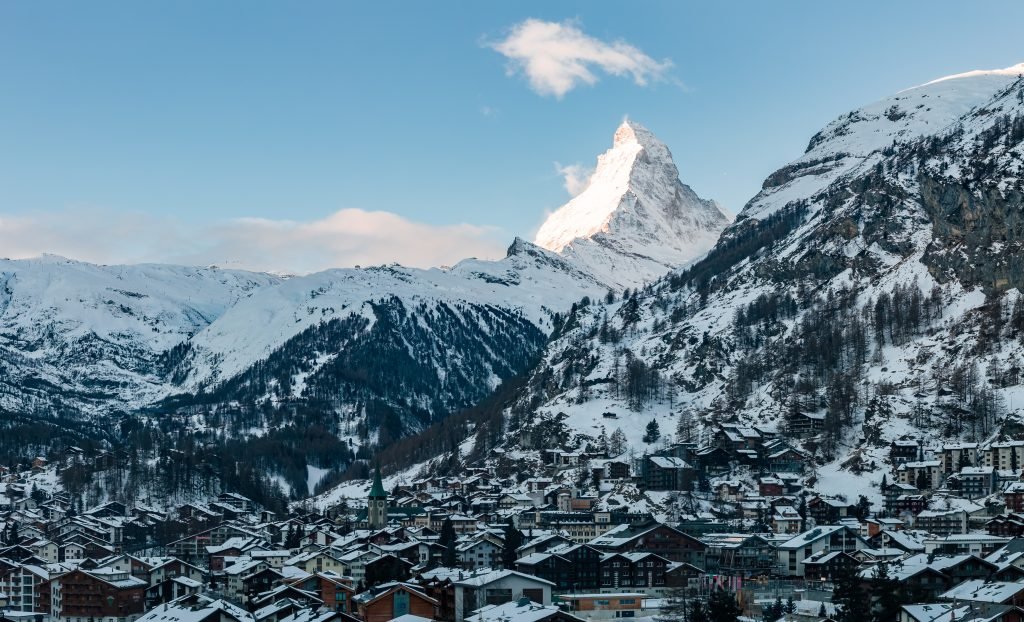
Car-free, glacier skiing into the summer, the highest lift-served terrain in Europe and the Matterhorn in every window that faces the right way. If the skiing is the point, Zermatt is the answer and it is not close.
The trade-off is that Zermatt is a working resort town of considerable scale, not a discreet enclave. You will queue. The luxury is in the hotels rather than in the experience of being there.
Verbier: for people who actually ski
The 4 Vallées is the largest linked domain in Switzerland and Verbier’s reputation is built on steep off-piste rather than on hotel lobbies. Younger, louder and more athletic than the other four. The luxury accommodation skews towards chalets rather than grand hotels, which changes the whole shape of a booking.
Andermatt: the one that has changed most
Fifteen years ago Andermatt was a faded garrison town. Sustained investment has turned it into a genuine luxury destination with a linked Sedrun ski area and a reputation for snow reliability. It is the value option of the five, and the least socially performative, which for some people is the entire appeal.
Ski-in ski-out is rarer than the brochures suggest
This is the most common disappointment in Alpine booking and it is worth being blunt about.
Swiss resort towns mostly grew in valleys, and the grand hotels were built in the towns rather than on the slopes. Very few genuine five-star hotels in St Moritz, Gstaad or Zermatt are true ski-in ski-out. What most offer instead is a ski concierge, boot storage at the lift station and a shuttle, which is a perfectly good substitute and is not the same thing.
If ski-in ski-out is non-negotiable, you are looking at chalets or at Andermatt, where the newer development was designed around the lift.
What a week actually costs
Here is where we can be genuinely useful, because the hotel rate is roughly half the true spend and no operator has any incentive to tell you that.
For two adults, seven nights, at a five-star Swiss hotel, budget for the following on top of the room:
Lift passes. A six-day adult pass at a major Swiss resort runs to several hundred francs per person. Zermatt’s is among the most expensive in the Alps, and the international pass covering Cervinia costs more again. Check the specific pass on the resort’s own site rather than a third party, because the pricing tiers change by date.
Transfers. Geneva to Verbier or Gstaad is roughly two hours by private car. Zurich to St Moritz is longer. A private transfer for two is a meaningful line item in each direction, and the train is genuinely excellent in Switzerland and considerably cheaper.
Ski and boot hire. Per person, per week, at performance level, this is not trivial.
Instruction. A private instructor for a day in a top Swiss resort is one of the largest single costs in the whole trip and is charged by the half or full day.
Mountain lunches. The one everybody forgets. Lunch on the mountain in Switzerland at a decent restaurant, for two, every day for six days, adds up to a number that surprises people.
The practical instruction: when you compare two hotels, add the same fixed costs to both, then compare. A hotel a hundred francs cheaper per night that requires a longer transfer and sits further from the lift is frequently not cheaper at all.
If you are not actually skiing
A significant share of guests in these hotels do not ski, and there is no shame in building the trip around that.
The Dolder Grand in Zurich, which we scored 9.2, is the strongest non-ski Alpine-adjacent option we have reviewed anywhere in Switzerland. An 1899 curhaus rebuilt by Foster and Partners, hung with Warhol and Miró, 175 rooms on the Adlisberg above the city and lake, reached by the Dolderbahn rack railway. Two Michelin stars under Heiko Nieder. The spa runs to 4,000 square metres across three floors, with an indoor pool, an outdoor whirlpool that is at its best in winter, a snow room and separate bath houses. Our reviewer called it the best in urban Switzerland.
It is not a ski hotel and does not pretend to be. It is an excellent way to have a Swiss winter week without buying a lift pass, and it pairs well with day trips into the mountains by train. Our piece on the new wave of Alpine wellness retreats covers the wider category.
Switzerland or France?
The comparison most readers are actually making, so here is a straight answer.
Choose France if the skiing volume matters most and you want more mountain for the money. The Three Valleys is larger than anything in Switzerland, the food is better at every price point, and the whole trip costs materially less. Our guide to the best luxury ski hotels in the French Alps covers the properties, including Aman Le Mélézin, which sits directly on the Bellecôte piste in Courchevel 1850 and is one of the genuine ski-in ski-out options at this level anywhere in the Alps.
Choose Switzerland if you want the mountain itself to be the spectacle, if snow reliability at altitude matters, or if the resort’s atmosphere is part of what you are buying. Zermatt’s terrain and the Engadin’s light have no French equivalent.
Our view: for a first luxury ski trip, France is better value and easier to get right. For a fifth one, Switzerland is where you go when you have stopped counting.
Booking well from here
Early booking offers are live now for the 2026 and 2027 season, and the discount is real at the chalet and operator end. At the grand hotels it is usually availability rather than price that you are securing.
Christmas and New Year is the steepest premium of the year in the Alps, steeper than February half term. If your dates are flexible, mid January is the best combination of snow, price and emptiness. Our guide to luxury Christmas hotel breaks covers the festive calculation in more detail.
Book the transfer when you book the room. Private transfers into the Swiss resorts sell out around peak weeks, and the train, while excellent, requires more planning with ski luggage than people expect.
For everything we have published on the country and the category, see our Switzerland destination guide, the ski collection and the mountain collection.
Frequently Asked Questions
Which Swiss ski resort is the most luxurious? St Moritz and Gstaad compete for it, and they are different products. St Moritz is social and visible, with a season that runs regardless of snow. Gstaad is quieter and more private. Zermatt has the best mountain but is a working resort town rather than an enclave.
Is St Moritz or Gstaad better? St Moritz if you want the scene and the frozen-lake events, Gstaad if you want understatement. Neither has skiing to match Zermatt or Verbier, so if you intend to ski hard for six days, choose differently.
When should I book a Swiss ski hotel? Now, for the 2026 and 2027 season. Early booking offers are live in August and the best suites at the grand hotels are committed by October. Christmas, New Year and February half term go first.
Is Switzerland more expensive than France for skiing? Yes, substantially, and the gap is wider than the hotel rates alone suggest once lift passes, ski hire, instruction and mountain lunches are counted. France offers more skiable terrain for the money.
Which Swiss resorts have genuine ski-in ski-out luxury hotels? Very few. Most grand hotels in St Moritz, Gstaad and Zermatt sit in the town rather than on the slope and offer a ski concierge and shuttle instead. Andermatt’s newer development is the best bet for true slopeside access.
When does The Park Gstaad open under Four Seasons? Summer 2027, according to the Four Seasons press release, with 75 rooms and suites following a refurbishment by Joseph Dirand. Several published roundups have given the 2026 to 2027 winter season, which appears to be incorrect.
Where should I stay in Switzerland in winter if I do not ski? The Dolder Grand in Zurich, which we scored 9.2, is our pick. A 4,000 square metre spa, two Michelin stars and the mountains reachable by train for day trips, without buying a lift pass.
Which Swiss resort has the most reliable snow? Zermatt, with the highest lift-served terrain in Europe and glacier skiing that runs into summer. Andermatt has built a strong snow-reliability reputation as well.