Dubai is a city built for cars, and that single fact decides more about your holiday than the hotel you choose. A room on the Palm and a room in Downtown can carry the same nightly rate and produce completely different weeks. One of them puts you forty minutes from dinner. The other puts you nowhere near the sea. Nobody tells you this at the point of booking, because the photographs all look the same and every property claims to be centrally located.
This is an honest guide to where to stay in Dubai, area by area, with real journey times rather than optimistic ones. We cover Palm Jumeirah, Downtown, Jumeirah and Umm Suqeim, the Marina and JBR, DIFC and Business Bay, Bluewaters, Jumeirah Bay Island and Old Dubai, with the hotels worth booking in each and the trade-offs nobody mentions.
First, the two questions that decide everything
Before you compare hotels, answer these.
Do you want the beach or the city? Dubai’s beach is on the western edge and its urban centre is inland, along Sheikh Zayed Road. The two are not adjacent. A beach resort with a skyline view is still a twenty-five minute drive from that skyline.
How many times a day will you leave the hotel? This is the question people get wrong. If you plan two or three outings daily, distance compounds fast, and a location that saves twenty minutes each way saves you two hours a day. If you plan to sit by a pool for six days, distance is almost irrelevant and you should simply buy the better resort.
Everything below follows from those two answers.
Palm Jumeirah: the resort choice, with a caveat
The Palm holds the highest concentration of serious beach resorts in the city. Atlantis The Royal, One and Only The Palm, the Waldorf Astoria, Jumeirah Zabeel Saray, Anantara and Fairmont The Palm sit on the fronds or the crescent, most with genuine private beach and calm, sheltered water.
The caveat is the road. The Palm has one trunk road in and out, and it is not designed for the volume it now carries. From the crescent to Downtown is typically thirty to forty minutes, and it can pass fifty at the end of a weekend. From Dubai International, allow forty-five minutes. The monorail helps within the Palm itself but does not solve the wider journey.
Within the Palm, position matters enormously and rates do not always reflect it. The crescent gives you privacy, skyline views and the longest drive. The trunk, near Nakheel Mall, cuts around fifteen minutes off every journey and usually costs less. Fairmont The Palm sits on the trunk, which is a large part of why we rate it as sensibly as we do: private beach, serious kids’ provision and better restaurants than the rate suggests, without the crescent’s isolation.
Book the Palm if the resort is the holiday, you are travelling with children, or you want the best beach-to-room ratio in Dubai. Avoid it if you are here for four nights and intend to see the city.
Downtown Dubai: the city choice
Downtown is the Burj Khalifa, the Dubai Mall, the fountain and the Opera district, and it is the only part of Dubai that behaves like a walkable city centre. The Address Sky View, Armani Hotel Dubai and the Palace Downtown all sit within a few minutes of each other, and the metro Red Line runs alongside.
What you gain is time. Restaurants, galleries, the mall and the old souks by taxi are all close, and journeys to the airport run fifteen to twenty minutes. What you give up is the sea. Downtown hotel pools are handsome rooftop affairs, but there is no beach, and the drive to one is twenty-five minutes.
Book Downtown if this is a short trip, a first trip, a business trip, or a stopover. It is also the strongest choice in the hot months, when the beach is barely usable in the middle of the day and the malls are where the city actually lives.
Jumeirah and Umm Suqeim: the compromise that works
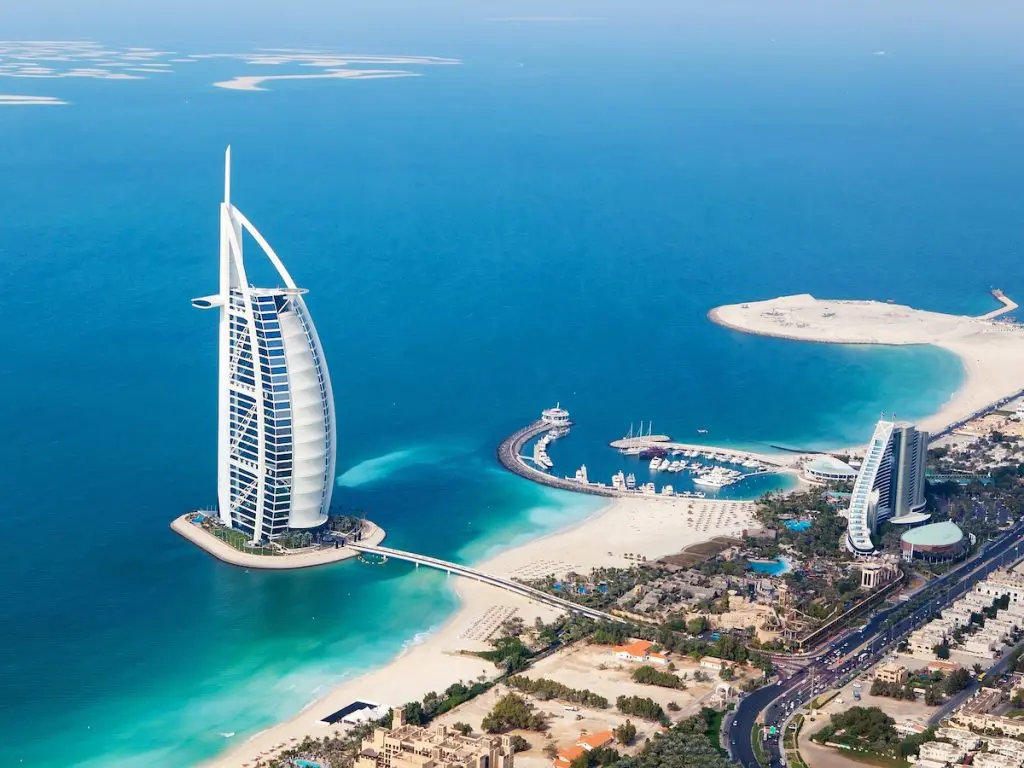
The strip running along Jumeirah Beach Road from the Dubai Water Canal to Burj Al Arab is where the compromise between beach and city genuinely holds, and it is where both of our highest-scoring Dubai reviews sit.
Four Seasons Resort Dubai at Jumeirah Beach occupies real sand with the skyline behind it and Downtown fifteen minutes away. It is the city-beach resort done properly, and it scores 9.0 in our review, the highest of any property we have stayed in across the Emirates. Mandarin Oriental Jumeira holds a similar position with a sleeker, more adult feel, one of the best spas in the city and a stronger dining programme. Further along, Bulgari sits on its own island, and Jumeirah Al Naseem and Al Qasr anchor the Madinat Jumeirah complex beside Burj Al Arab.
This is the answer for most people, and it is under-recommended because the area has no single famous landmark to sell it. Journey times are honest here: Downtown in fifteen to twenty minutes, the airport in twenty-five, the Marina in twenty.
The trade-off is that there is no metro station within walking distance of the beach hotels, so you will use taxis constantly. Budget for it. Fares are low by European standards, but four or five journeys a day add up over a week.
Dubai Marina and JBR: value and volume
The Marina is the densest cluster of towers in the city, and JBR is the beachfront strip attached to it. Rates run noticeably lower here than on the Palm for comparable brands, and the area has something almost nowhere else in Dubai does, which is street life. You can walk to dinner. You can walk along the beach at night and find it busy.
The compromise is atmosphere. JBR beach is public and lively rather than serene, the towers block afternoon light on parts of the sand, and the surrounding blocks feel more residential than resort. Downtown is twenty-five to thirty minutes away and the airport is a solid forty.
Book the Marina if you want a beach holiday at a lower rate, you are travelling as a group, or you want to be able to leave the hotel on foot. Skip it if quiet is what you are paying for.
Bluewaters Island: the newer alternative
Bluewaters sits just offshore from JBR, connected by a footbridge, and holds Caesars Palace and Ain Dubai alongside a compact promenade of restaurants. It offers a beach and walkable dining with slightly more calm than JBR itself.
It is a good middle option for people who like the Marina’s convenience but not its density. Journey times mirror the Marina, so treat it as the same location with a better address.
DIFC and Business Bay: for work, and for restaurants
The financial district is where Dubai’s restaurant scene has settled. The Waldorf Astoria DIFC, the Ritz-Carlton DIFC and the Four Seasons DIFC all sit within a short walk of the Gate Village galleries and a concentration of dining that outperforms anything on the coast.
Business Bay, immediately south, is cheaper, taller and less interesting, but it puts you five minutes from Downtown and close to the canal.
Book DIFC if you are working, if food is the reason you travel, or if you want a city hotel with a proper spa and no beach obligation. The airport is fifteen to twenty minutes away, the shortest transfer of any luxury district in the city.
Jumeirah Bay Island and the quiet corners
Jumeirah Bay Island, home to Bulgari Resort Dubai, is the closest Dubai comes to seclusion within the city. It is a private island reached by causeway, ten minutes from Jumeirah Beach Road and about twenty from Downtown, with a marina, a small beach and very little else. That is the point.
The same logic applies to Pearl Jumeira and, further out, the desert. Al Maha and the desert camps are not Dubai at all in practice, and a night or two out there works far better appended to a city stay than as a base.
Beyond Dubai: the northern emirates
One option most visitors never consider is basing part of the trip outside Dubai entirely. Rates fall sharply and the beaches get quieter within an hour’s drive.
Waldorf Astoria Ras Al Khaimah is a palatial, family-friendly resort on Al Hamra beach that trades hype for genuine calm, and Fairmont Ajman delivers a proper beach resort at northern-emirates prices around forty minutes from Dubai’s noise. On the east coast, Fairmont Fujairah is the unhurried option. Abu Dhabi is a ninety-minute drive and worth a night of its own; Fairmont Bab Al Bahr has the Sheikh Zayed Grand Mosque view across the creek.
A common and effective structure for a ten-day trip is four nights in Jumeirah, three in the northern emirates and two in Abu Dhabi. Everything we have reviewed across the country sits on the United Arab Emirates hub.
Old Dubai: Deira, Bur Dubai and the Creek
The historic quarters around Dubai Creek hold the gold and spice souks, Al Fahidi’s wind towers and the abra crossings, and they are the part of the city most visitors under-use. Hotel stock here is thinner at the luxury end, though Dubai Creek Harbour is changing that.
We would not base a first trip here, but we would spend a morning here on every trip. From Downtown it is a twenty minute drive. From the Palm, closer to fifty.
Journey times you can plan around
Approximate driving times outside peak traffic. Add a third during Friday evenings and the weekend rush.
- Palm Jumeirah crescent to Downtown: 30 to 40 minutes
- Palm Jumeirah crescent to DXB airport: 40 to 50 minutes
- Downtown to DXB airport: 15 to 20 minutes
- Jumeirah Beach Road to Downtown: 15 to 20 minutes
- Dubai Marina to Downtown: 25 to 30 minutes
- Dubai Marina to DXB airport: 35 to 45 minutes
- DIFC to DXB airport: 15 to 20 minutes
- Downtown to Old Dubai and the souks: 20 minutes
- Anywhere central to Al Maktoum (DWC) airport: 45 to 60 minutes
- Dubai to Abu Dhabi: 80 to 100 minutes
One correction to a common assumption: the metro is genuinely useful along the Red Line corridor, which links the Marina, Mall of the Emirates, Downtown and the airport. It does not serve the beach hotels on Jumeirah Beach Road, and it does not serve the Palm crescent. Current network maps and fares are on the Roads and Transport Authority site.
When you go changes where you should stay
Dubai’s season runs from November to March, when daytime temperatures sit in the mid twenties and the beach works. This is when a Palm or Jumeirah resort earns its rate, and it is also when rates peak.
From June to September, daytime highs pass forty degrees with high humidity, and outdoor time is limited to early morning and late evening. Rates fall by half or more. In those months a Downtown or DIFC base is the better decision, because you will spend your days indoors and your evenings in restaurants, and a beach you cannot use is not worth a forty minute commute.
April, May and October are the shoulder months, and they are the best value in the calendar if you can tolerate heat in the mid to high thirties. Ramadan dates shift each year and change restaurant and bar hours considerably, so check them before booking; Visit Dubai publishes the current guidance.
Four mistakes we see repeatedly
Booking the crescent for a short trip. The far end of Palm Jumeirah is beautiful and it is forty minutes from most things. On a four-night trip that is roughly five hours in a car.
Assuming a beach view means beach access. Several Dubai hotels advertise sea views from towers that sit across a road from the water, with no private sand at all. Check for the words private beach, not beachfront.
Ignoring the hotel’s own transport. Most resorts run scheduled shuttles to the Dubai Mall and the malls, included in the rate. Using them instead of taxis changes the economics of a Palm or Marina stay considerably, and almost nobody asks at check-in.
Booking summer rates without checking the pool. Between June and September, unchilled pools reach bath temperature by mid-morning. Chilled pools are the single most valuable summer amenity in the city and are not always mentioned in the listing.
How to choose your area in Dubai
Work through these in order.
- Four nights or fewer, first visit: Downtown. You will see more and drive less, and the city reveals itself faster from the centre.
- A week, beach-led, with children: Palm Jumeirah, on the trunk rather than the far crescent. Better beach, shorter drives, lower rates.
- A week, beach and city in equal measure: Jumeirah or Umm Suqeim. The single best compromise in Dubai and the answer we give most often.
- Value, walkability, group travel: Dubai Marina or JBR.
- Food, work, short transfers: DIFC.
- Privacy above all: Jumeirah Bay Island, then a desert night at the end.
- Ten days or more: split the stay. Dubai, then the northern emirates, then Abu Dhabi.
- Summer travel: Downtown or DIFC, regardless of what you would choose in winter.
Frequently asked questions
Where is the best area to stay in Dubai for first-time visitors?
Downtown Dubai. It is the most walkable district, sits on the metro Red Line, and puts the Burj Khalifa, the Dubai Mall and the Opera district within a few minutes. The airport is fifteen to twenty minutes away.
Is Palm Jumeirah worth staying on?
Yes, if the resort is the point of the trip. The beach and the hotel stock are the best in the city. It is the wrong choice for a short trip focused on seeing Dubai, because the single access road makes every journey longer than the map suggests.
Which area has the best beach?
Palm Jumeirah for calm, private, sheltered water, and Umm Suqeim and Jumeirah for natural beach with the city behind it. JBR has the liveliest public beach but the least seclusion.
Do I need a car in Dubai?
No. Taxis and ride-hailing are inexpensive and plentiful, and the metro covers the Sheikh Zayed Road corridor well. A car is only worth it if you plan multiple desert or Abu Dhabi trips.
Where should I stay in Dubai in summer?
Downtown or DIFC. Between June and September the beach is unusable for much of the day, so proximity to indoor dining, malls and museums matters more than sand. Rates in those months fall sharply.
How far is Dubai Marina from Downtown?
Twenty-five to thirty minutes by car outside peak times, and closer to forty in Friday evening traffic. The metro Red Line connects the two and is often faster.
Is it cheaper to stay outside Dubai?
Considerably. Ras Al Khaimah, Ajman and Fujairah all offer full beach resorts at a fraction of Dubai rates, within forty to ninety minutes by road. They work best as part of a split stay rather than as a base for sightseeing.
The short answer
If you want one recommendation rather than eight: stay on Jumeirah Beach Road or in Umm Suqeim. You get a real beach, a fifteen minute run into Downtown, an airport transfer under half an hour, and hotels that hold their own against anything on the Palm. It is the only area in Dubai where you do not have to choose between the sea and the city, and it is not a coincidence that our two highest-rated Dubai properties both sit there.
Browse every review we have published in the city on the Dubai destination page, or start from the Beach collection if sand is the deciding factor.