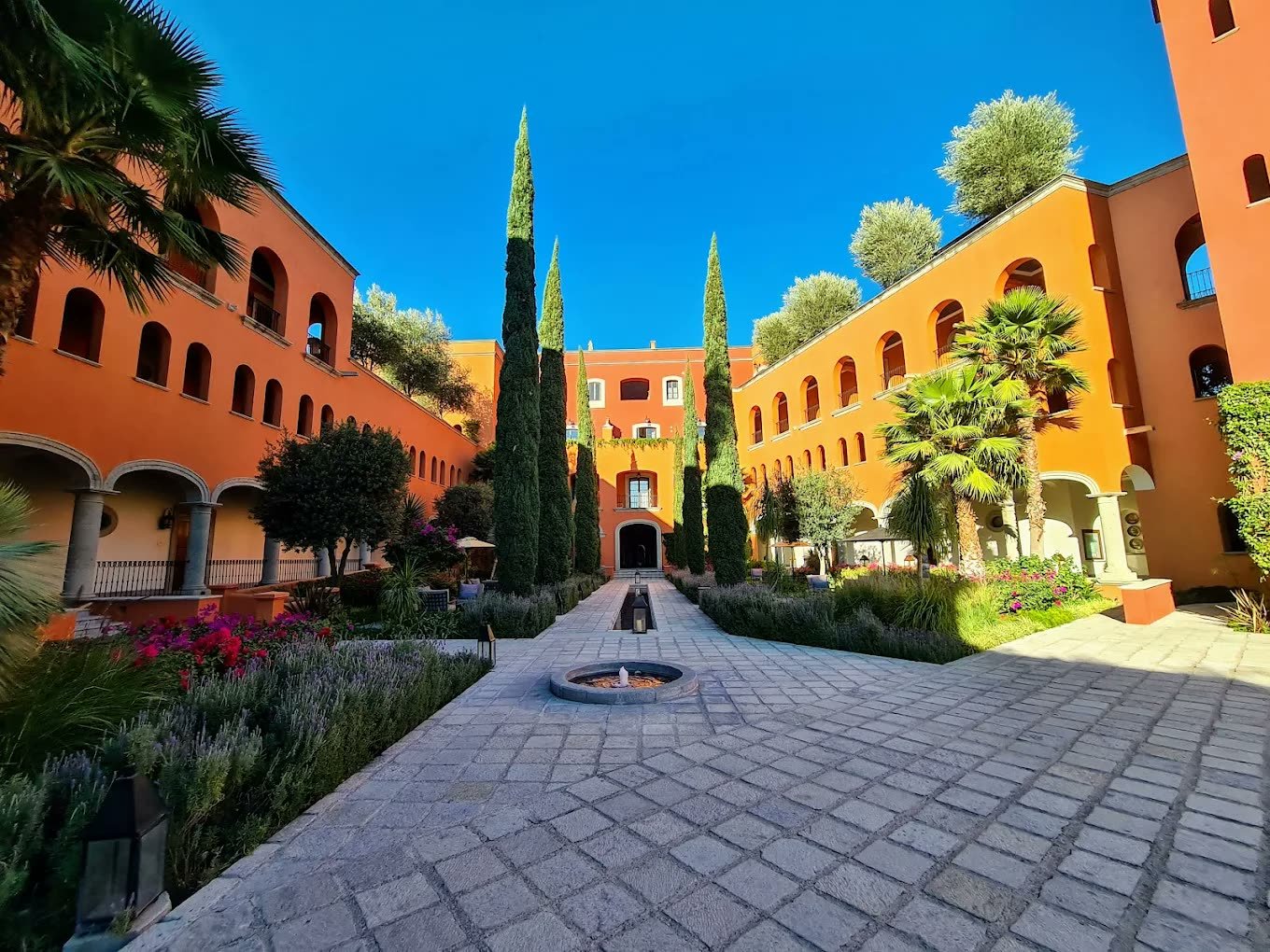
Fatima Zahra has run her family’s riad in the Kasbah quarter for fifteen years, and she still tells new guests the same thing at check-in: leave your phone’s GPS on, but don’t trust it past the first turn. The medina doesn’t organize itself the way a map wants it to. Alleys narrow, double back, dead-end into a carpet workshop or a courtyard door with no sign. Then, without warning, you push through one more unmarked door and the noise outside just stops. A fountain. A citrus tree. Four floors of carved cedar and zellige tile built around a square of open sky. That door is the entire argument for staying in the medina, and it’s also the thing no drone shot of the Palmeraie’s pools can capture.
A luxury Marrakech travel guide has to start with a single decision: medina riad or Palmeraie resort, because those two experiences barely resemble each other. One puts you inside a thousand-year-old walled city, behind an unmarked door, with the souks a five-minute walk away. The other puts you fifteen minutes outside it, behind a much bigger gate, surrounded by palm groves and quiet. Both are legitimately luxurious. They are not the same trip.
What Marrakech Actually Is
Marrakech is loud before it’s beautiful, and beautiful because it’s loud. The Djemaa el-Fna square at dusk — smoke from the food stalls, snake charmers, the call to prayer layering over all of it — is not staged for tourists so much as tolerant of them. The medina itself is a UNESCO-listed maze dating to 1062, and it was never designed to be legible to outsiders. That’s not a flaw. That’s the point.
Here’s the expectation flip worth sitting with: most people arrive expecting the chaos to be constant. It isn’t. The riad door is a hard line between the two states of Marrakech — total sensory noise outside, near-total silence inside. Nowhere else does luxury travel offer that particular whiplash, and it’s the reason a well-chosen riad outperforms an equivalently priced hotel almost anywhere else in the world.
Best Time to Visit Marrakech
March through May, and again October through November, are the best times to visit Marrakech, with daytime temperatures sitting in a genuinely comfortable 22–28°C range.
April is the standout month — gardens in full bloom, bougainvillea spilling over walls, the Atlas Mountains still snow-capped in the distance for a striking contrast against the warming city below. October runs a close second, with clear, mild days ideal for full afternoons in the medina without wilting.
Avoid July and August outright. Temperatures regularly clear 40°C, and the heat radiating off the medina’s stone alleys makes even short walks between sights uncomfortable. The trade-off: riad rates drop 30–50% in summer and again in January and February, so if budget outweighs comfort, those windows exist for a reason.
A Luxury Marrakech Travel Guide: Medina or Palmeraie
Medina Riads: The Interior Life
Staying inside the medina walls means everything is walkable — the souks, Bahia Palace, the tanneries, dinner at a rooftop restaurant with the Koutoubia minaret lit up above the skyline. It also means narrow alleys cars can’t enter, so your luggage finishes the last stretch to your riad by cart or by hand.
Royal Mansour is the medina’s most ambitious property: 53 private riads built specifically for guests, each with its own plunge pool, butler, and rooftop terrace, plus a Michelin-starred restaurant from chef Yannick Alléno. It is less a hotel than a purpose-built village inside a village.
La Mamounia, open since 1923 and set within eight hectares of gardens Winston Churchill famously painted, remains the medina’s most storied address — three pools, an extensive spa, and the kind of history that makes the current stay feel like a continuation of something rather than a transaction.
For a smaller, more intimate register, the Angsana Heritage Collection (Banyan Tree’s restored historic properties, including Riad Bab Firdaus) and independent riads like Riad Kheirredine and Riad Antara, tucked near Bahia Palace in a former Saadian residence, deliver the tadelakt-and-zellige riad experience at a more personal scale.
Palmeraie Resorts: The Decompression
Fifteen to twenty-five minutes north of the medina, La Palmeraie is a 13,000-hectare palm grove home to Marrakech’s resort-style luxury — golf courses, sprawling pools, and a stillness the medina simply cannot offer.
Amanjena, Aman’s only property on the African continent, sets the benchmark here, with private pavilions arranged around a vast reflecting pool lined by twelve-meter palms, and rates that generally run from around $700 to $1,500 a night depending on season. Es Saadi and Selman round out the Palmeraie’s upper tier, each trading the medina’s density for space, quiet, and a proper pool day.
The honest move, and the one most repeat visitors eventually land on: spend two or three nights in the medina first, then finish with one or two nights in the Palmeraie as the decompression stage of the trip. Noise, then space. It’s a sequence, not a choice you have to make once and live with.
How to Get Around Marrakech
Inside the medina, walking is the only real option — cars can’t enter most of it, and that’s exactly why it stays intact. Download the medina on Google Maps or Maps.me before you land, since data connections inside the alleys can be unreliable, and treat getting mildly lost as part of the experience rather than a failure of navigation.
Between the medina and anywhere else — Gueliz, the Palmeraie, the airport — petit taxis are the standard, small beige cars capped at three passengers. Insist on the meter before getting in: “le compteur, s’il vous plaît.” If a driver refuses and quotes a flat rate instead, it’s entirely normal to decline and wait for the next one; another will come within minutes. Ride-hailing apps like Careem and InDrive have also become reliable options, with fixed pricing shown upfront, which removes the negotiation entirely.
One logistics note worth knowing ahead of time: taxis can reach the medina’s main gates — Bab Doukkala, Bab Ghmat, Bab Debbagh — but not the interior alleys. From there, it’s on foot, sometimes with a porter, to the riad door itself.
Who Marrakech Is For
It’s for travelers who want their luxury to come with texture — history, craft, a sense of being somewhere specific rather than somewhere generically beautiful. It’s for honeymooners who want romance with an edge of genuine adventure, not just a pool and a view. It’s for anyone who finds a five-star hotel lobby a little boring and would rather it be a carved cedar door instead.
It is not for travelers who want total predictability. The medina asks you to get a little lost, to negotiate a little, to accept that not everything will run exactly on schedule. If that sounds like friction rather than charm, the Palmeraie resorts offer a gentler, more contained version of Marrakech — still worthwhile, just a different kind of trip. And if any friction at all feels like too much, this may not be the destination, full stop.
Fatima Zahra still says the same thing to guests leaving her riad as she did on arrival: keep the GPS off past the first turn, and let the door find you. It always does, eventually. That’s the whole trick of Marrakech — the getting lost is the itinerary.
Frequently Asked Questions
What is the best time to visit Marrakech? March to May and October to November, when daytime temperatures sit in a comfortable 22–28°C range and gardens are at their best.
Should I stay in the medina or Palmeraie in Marrakech? Stay in the medina for culture, walkability, and souk access; stay in the Palmeraie for space, pools, and quiet. Many travelers do both, sequencing medina first and Palmeraie last.
What are the best riads in Marrakech? Royal Mansour and La Mamounia lead the medina’s luxury tier, with the Angsana Heritage Collection, Riad Kheirredine, and Riad Antara offering more intimate, smaller-scale alternatives.
Is Marrakech good for a luxury honeymoon? Yes — a private riad in the medina followed by a night or two at a Palmeraie resort like Amanjena is a well-worn, well-loved honeymoon pairing.
How many days do you need in Marrakech? Four to five days is enough to properly settle into the medina and add a Palmeraie stay, plus a day trip toward the Atlas Mountains if time allows.
Is it safe for women to travel in Marrakech? Generally yes, especially with the usual city-travel precautions — modest dress in the medina, confident navigation of taxi negotiations, and a reputable riad as a home base.
Do you need a guide in the Marrakech medina? Not strictly, but a guide for your first day is worth it — it shortcuts the learning curve on navigation and gives context to what you’re walking past.
What is the difference between a riad and a hotel in Marrakech? A riad is a traditional courtyard house, usually small and privately run, built around an interior garden or pool. A hotel is typically larger, resort-style, and often located outside the medina in areas like the Palmeraie or Hivernage.