The best 5 star hotels in Japan fall into four groups: the tower hotels of central Tokyo, the garden properties of Kyoto, a strengthening Osaka set led by Four Seasons, and a short list of ryokan that charge city-hotel rates and earn them. Ten are below, all confirmed open and taking bookings as of September 2026, with the specific reason to choose each one.
What five star actually means in Japan
Japan has no government star rating. When a hotel is sold as a five star property here, that comes from Forbes Travel Guide ratings, booking platform classifications, or the hotel simply operating at that standard. Compare what varies instead. Rooms at this level are generally large by capital city standards, and the bathroom is usually a separate wet room with a deep soaking tub. Breakfast is often charged separately at hotels and included at ryokan.
The second split matters more than the brand. A hotel gives you flexible check-in, all-day dining and a concierge. A ryokan sets a check-in window, serves two fixed meals, and expects you there for both. Do both on one trip. They are not interchangeable.
Best 5 star hotels in Japan at a glance
- Aman Tokyo, Otemachi: quietest large-room stay in central Tokyo, 30 metre pool.
- Janu Tokyo, Azabudai Hills: wellness-led and more social, 122 rooms in Minato.
- Mandarin Oriental, Tokyo, Nihonbashi: upper floors of a tower, strong on food.
- Four Seasons Hotel Kyoto, Higashiyama: ancient pond garden, temples on foot.
- Aman Kyoto, Takagamine: forest setting north of the city, private onsen in some rooms.
- The Ritz-Carlton, Kyoto, Nakagyo-ku: on the Kamogawa, closest of the three to Gion.
- Four Seasons Hotel Osaka, Dojima: opened July 2024, ryokan-style Gensui floor.
- The Ritz-Carlton, Osaka, Umeda: European grande dame two minutes from Osaka Station.
- Hoshinoya Kyoto, Arashiyama: reached by private boat along the Oi river.
- Gora Kadan, Hakone: onsen ryokan on former imperial villa grounds.
The best 5 star hotels in Tokyo
Tokyo’s top hotels are vertical and clustered by ward, so this is really a neighbourhood decision. Otemachi and Nihonbashi are business districts that empty out after work, which is why they are quiet. Minato and Shibuya are where the late bars are. Our Tokyo neighbourhood guide covers what each district is like after dark.
Aman Tokyo, Otemachi
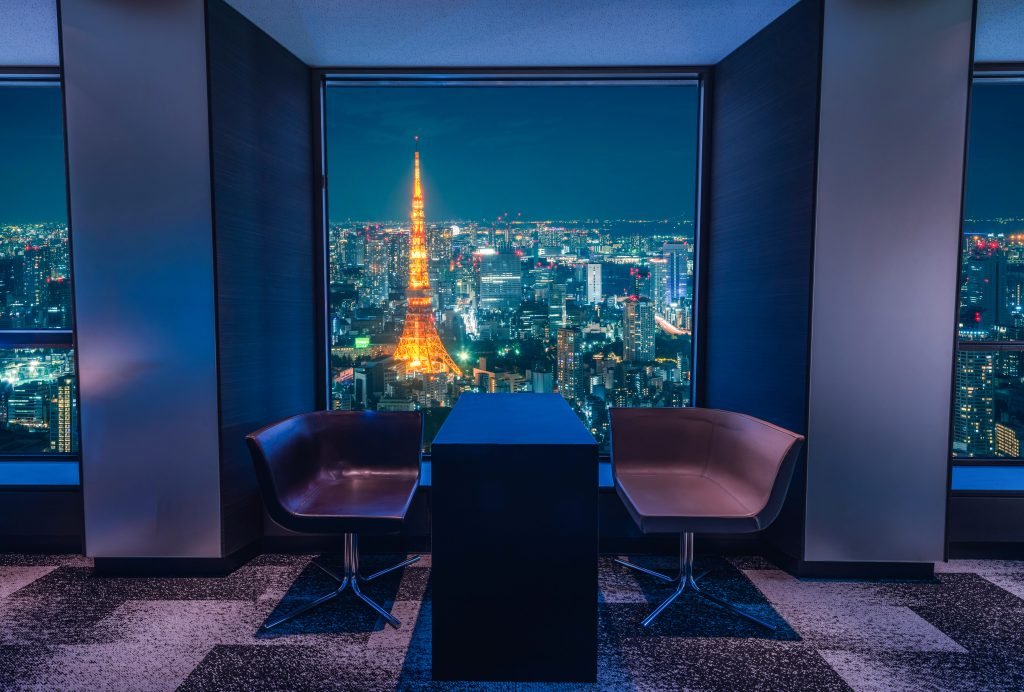
Aman Tokyo occupies the top floors of the Otemachi Tower in Chiyoda, and the rooms are among the largest in the city. The spa has onsen-style hot baths and steam rooms, a 30 metre pool with views across Tokyo, and separate yoga and Pilates studios. Dining runs from Arva for Italian to Musashi for omakase sushi. Tokyo Station is a short walk, which makes this the easiest base for shinkansen day trips. Choose it for silence and floor space.
Janu Tokyo, Azabudai Hills
Janu is Aman’s second brand, and Janu Tokyo is the only hotel in Azabudai Hills, the Minato development it opened alongside. It has 122 rooms, eight dining and entertainment spaces, a pool, and a wellness centre of around 4,000 square metres, which is unusual even by Tokyo standards. The tone is deliberately less hushed than Aman Tokyo: more bar, more gym, more people in the lift. Pick it if you want to train hard in the morning and eat well at night without leaving the building.
Mandarin Oriental, Tokyo, Nihonbashi
The Mandarin Oriental sits on the upper floors of the Nihonbashi Mitsui Tower in Chuo, above one of the older commercial quarters of the city. Its long suit has always been the restaurant floors and the views from them. The tower connects underground to Mitsukoshimae station, which is a real advantage in August heat and the June rains. Nihonbashi is quiet at night but has excellent traditional shops and a short subway ride to Ginza.
The best five star hotels in Kyoto
Kyoto is the opposite problem to Tokyo. Most of what you came to see sits east and north, traffic is heavy during blossom and autumn leaves, and your address decides how much of the day you lose in a taxi. For the wider itinerary, see our Kyoto luxury travel guide.
Four Seasons Hotel Kyoto, Higashiyama
Four Seasons Kyoto is built around a pond garden the hotel dates to roughly 800 years ago, at Myohoin Maekawa-cho in Higashiyama-ku. That garden is the point: rooms and the tea house look on to it, and it is why the property reads as Kyoto rather than as a hotel that could be anywhere. Sanjusangendo is minutes away on foot, the Kyoto National Museum is close, and Kiyomizu-dera is a short taxi. It is also the easiest of the Kyoto three with children, because it runs as a city hotel rather than a retreat.
Aman Kyoto, Takagamine
Aman Kyoto is about 30 minutes by car from Kyoto Station in the northern Takagamine district, at the foot of Hidari Daimonji mountain, and it is effectively a private forest with pavilions in it. Two restaurants: Taka-An for Japanese cooking and The Living Pavilion for Western and local dishes. The spa runs on mineral-rich water from hot springs nearby, and some accommodation has its own onsen. Kinkaku-ji is very close. The trade-off is real: you will not walk back here from dinner in Gion.
The Ritz-Carlton, Kyoto, Nakagyo-ku
This is the central choice. It sits on the bank of the Kamogawa with the Higashiyama mountains opposite, and both Gion and the Teramachi shopping streets are walkable. The dining is unusually deep: kaiseki, sushi, tempura and teppan all run under the Mizuki name, with La Locanda for Italian and a Pierre Herme Paris boutique. The spa is a La Prairie spa, which the hotel describes as the first of its kind in Asia, and there is an indoor pool. Take it if walking back from a late dinner beats a garden view.
Five star hotels in Osaka, including Four Seasons Osaka
Osaka was the weakest of the three cities at the top end for years, and that has changed. Searches for five star hotels in Osaka now land on one of two properties, and they are nothing like each other.
Four Seasons Hotel Osaka, Dojima
Four Seasons Osaka opened in July 2024 in Dojima, Kita-ku, on the business island north of the river and within walking distance of Osaka Station. Its distinguishing feature is the Gensui floor, a ryokan-style floor inside the hotel with its own amenities and rituals, so you can try the format without giving up a city hotel’s flexibility. Restaurants include Jiang Nan Chun for Jiangsu, Zhejiang and Cantonese cooking, Sushi L’Abysse Osaka, and Bar Bota for cocktails. Take it if you are using Osaka as a base for Kyoto, Nara and Koyasan: the station is close and Osaka rates usually sit below Kyoto in peak weeks.
The Ritz-Carlton, Osaka, Umeda
The Ritz-Carlton has been in Umeda, Kita-ku for years and it is unapologetically European: the public rooms are dressed as an 18th century British aristocratic residence, which either appeals or does not. La Baie is French and holds a Michelin star according to the hotel, alongside Hanagatami for Japanese, Xiang Tao for Cantonese and Splendido for Italian. There is an indoor pool and hot tub, and the spa works with ESPA plus a sake-based treatment. Osaka Station is two minutes away. On the brands in general, we have Four Seasons and Ritz-Carlton compared.
High-end ryokan worth planning a trip around
A ryokan is usually the part of a Japan trip people describe first when they get home, and these two are priced accordingly. Two nights is the sensible maximum before fixed meal times start dictating your day. On the bathing side, see our guide to the best luxury hot springs resorts.
Hoshinoya Kyoto, Arashiyama
Hoshinoya Kyoto sits in the Ran-kyo gorge at Arashiyama in Nishikyo-ku, and you arrive by private boat along the Oi river. The boat must be reserved in advance, the first leaves the boat lounge at 2:30pm and the last at 5:45pm, so a late arrival into Kansai does not work as a first night. There is no parking and no shuttle, though luggage can be sent on from Kyoto Station or the airport. Across the water there are two restaurants, an onsen and a public bath, and no road noise. It is the strongest argument in Japan for paying for a location.
Gora Kadan, Hakone
Gora Kadan is in Gora, in Hakone, on the historic grounds of the Kan’in-no-miya villa, a summer retreat used by the imperial family until 1948. It is the standard answer to where you do a serious onsen ryokan within reach of Tokyo, since Hakone is a morning’s travel from the city. The group opened a second property, Gora Kadan Fuji, on 20 July 2025, with restaurants from Sushi Takumi and Japanese Cuisine Kanda. Book either well ahead for autumn leaves.
How to split a first trip between Tokyo, Kyoto and Osaka
A ten night trip divides cleanly: four nights in Tokyo, three in Kyoto, two at a ryokan, and one in Osaka at the end if you fly out of Kansai. On seven nights, cut Osaka rather than the ryokan. Osaka earns longer if you want to eat in Dotonbori and Fukushima properly. Put the ryokan in the middle of the trip, not at the start: fixed check-in windows and a 6pm kaiseki service are unforgiving after a long-haul arrival.
When to go, and what the seasons do to rates
Cherry blossom in late March and early April and autumn leaves in November are the two windows when Kyoto and Hakone sell out first and rates peak. Blossom dates move by a week or two each year, so if the trees matter more than the hotel, take a flexible rate. Summer is hot and humid in all three cities, and June brings the rains, which is when an underground link to a subway station stops being a footnote. Late January and February are the cheapest weeks. Ryokan rates also move with the kitchen, since kaiseki changes with the season.
Frequently asked questions
Does Japan have official five star hotel ratings?
No. There is no government star scheme in Japan, so five star here is shorthand drawn from Forbes Travel Guide ratings, booking site classifications and general reputation. Compare room size, bathroom layout and whether meals are included rather than counting stars.
Is Four Seasons Osaka better than Four Seasons Kyoto?
They do different jobs. Four Seasons Osaka opened in July 2024 in Dojima and works as a city base with fast station access and a ryokan-style Gensui floor. Four Seasons Kyoto is built around a pond garden the hotel dates to roughly 800 years ago and puts Higashiyama temples on foot. Choose Kyoto for sightseeing, Osaka for transport and value.
Should I book a five star hotel or a ryokan in Japan?
Do both on the same trip. Use hotels in Tokyo, Kyoto and Osaka for flexibility, then take one or two nights at a ryokan such as Hoshinoya Kyoto or Gora Kadan for the meals and the baths. Ryokan set check-in windows and fixed dinner times, so they suit the middle of an itinerary rather than an arrival night.
How far ahead should I book five star hotels in Japan?
For blossom season in late March and early April, and for autumn leaves in November, six to twelve months ahead is realistic for the best rooms in Kyoto and Hakone. Outside those windows two to three months is usually enough, though small ryokan go earlier.
Which five star hotel in Tokyo is the quietest?
Aman Tokyo, on the top floors of the Otemachi Tower, sits in a business district that empties in the evening, and it has some of the largest rooms in the city. Janu Tokyo in Azabudai Hills is the louder, more social alternative if you want bars and a large wellness centre on site.