



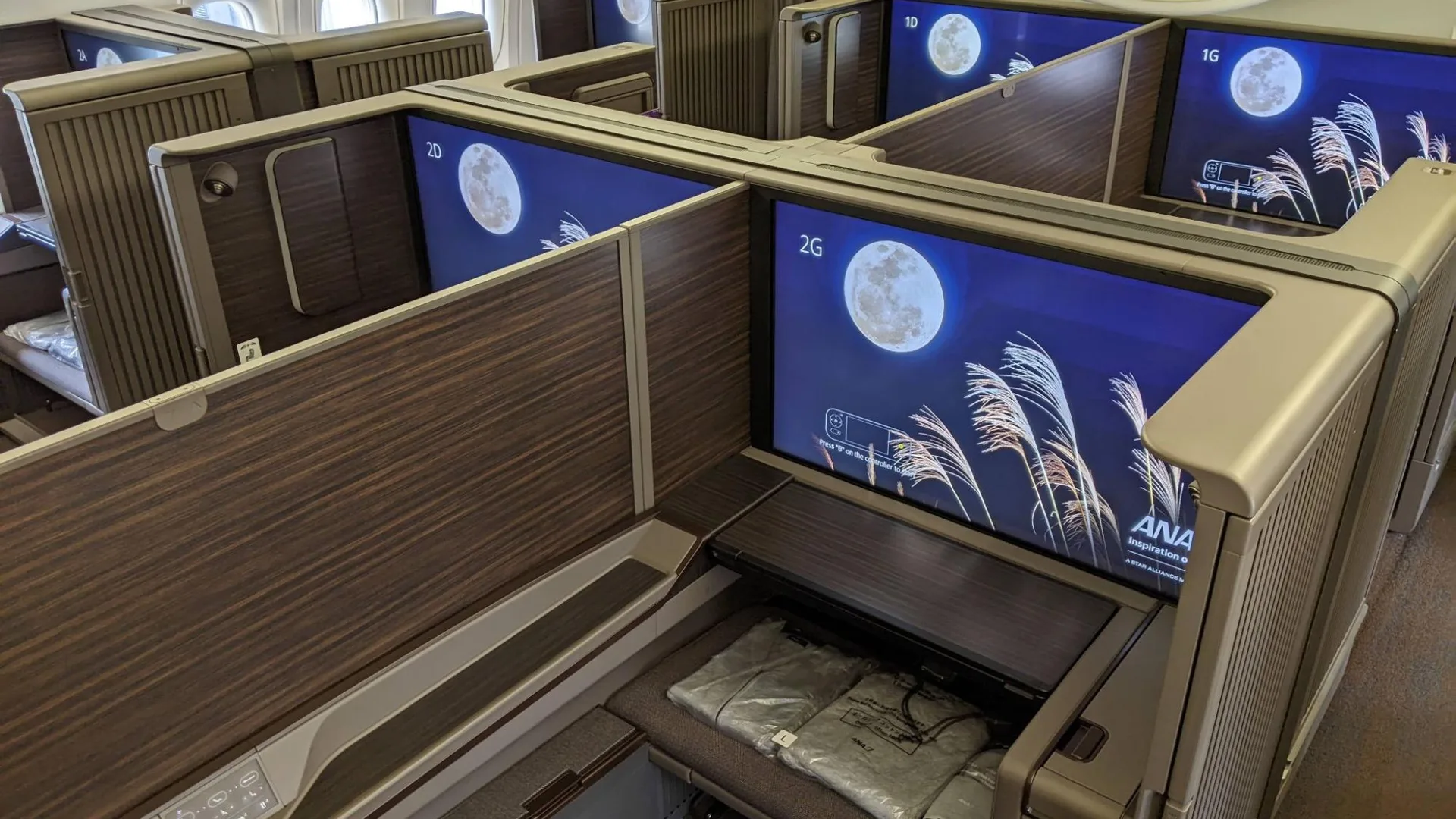
The doors slide shut. Not a curtain, not a divider — an actual door, the kind that clicks into place like you’ve checked into a very small, very quiet hotel room at 40,000 feet. That’s the moment people are chasing when they ask how to book ANA First Class with miles. It’s eight suites on the whole airplane, Japanese hospitality that doesn’t perform for you so much as simply take care of you, and a cash price that can run past $15,000 one-way. Almost nobody pays that. They use miles instead, and the path there is specific enough that it’s worth doing properly.
ANA First Class — flown in “The Suite” on select Boeing 777-300ER routes between Tokyo Haneda and cities like New York, Chicago, and San Francisco — can be booked with miles through ANA’s own Mileage Club, or by transferring points from Amex, Capital One, Marriott Bonvoy, Virgin Atlantic, or Air Canada Aeroplan. Round-trip pricing starts around 150,000 miles. This is the kind of redemption that pays for a wedding, a milestone, or a trip you’ll talk about for a decade — and it takes planning, not luck.
I’ve done enough Pacific crossings for shoots and retreats to know the difference a seat makes on a twelve-hour flight, and ANA’s Suite is one of the few products that genuinely earns the fuss around it. It’s also one of the harder bookings in this hobby. Here’s how it actually works.
Who This Redemption Is For
This is not a spontaneous booking. ANA releases a small number of First Class seats — typically one or two per flight — starting 355 days before departure, and they can vanish within minutes. This redemption rewards people who plan far ahead, hold (or can quickly build) a flexible points balance, and are willing to be flexible on exact dates or routing to catch open space.
It’s a strong fit if you’re already flying to Japan or planning a Tokyo stopover en route to somewhere else in Asia, if you have a milestone trip on the calendar a year out, or if you’re building a points strategy around one big redemption rather than several small ones. It’s a poor fit if you need to lock in dates now, if your only points are in a currency that doesn’t reach ANA space, or if you’re chasing the seat more than the trip — a $15,000 flight isn’t a bargain just because you paid in miles instead of dollars if the itinerary doesn’t actually serve you.
How to Book ANA First Class With Miles: Step by Step
There are three realistic paths into ANA’s First Class cabin. Each trades points required against fees, flexibility, and how the redemption is structured.
1. Book direct through ANA Mileage Club. Amex Membership Rewards transfers to ANA at 1:1, and Capital One miles also transfer at 1:1 — both are the cleanest way to fund an ANA Mileage Club account. Marriott Bonvoy transfers at 3:1, with a bonus that effectively turns 60,000 Bonvoy points into 25,000 ANA miles. As of 2026, ANA’s published chart runs by season: First Class round-trip between North America and Japan starts around 150,000 miles in low season and climbs toward 200,000 in high season. ANA also holds back some First Class inventory exclusively for its own Mileage Club members, which is a real advantage over booking through a partner program. The tradeoff: this route currently requires a round-trip itinerary when using partner miles, and taxes and fees, while modest, still apply.
2. Transfer to Virgin Atlantic Flying Club. Virgin Atlantic has historically offered some of the lowest point costs for ANA First Class — generally in the range of 70,000–85,000 points one-way between the U.S. mainland and Japan, less from Hawaii. Virgin raised these rates in a 2024 devaluation, so treat any number you see online as a starting point to verify, not gospel. The catch is that Virgin passes through ANA’s carrier-imposed surcharges, which can add several hundred dollars in taxes and fees on top of the points. Virgin Atlantic is a transfer partner of Amex Membership Rewards and Capital One, not Chase.
3. Transfer to Air Canada Aeroplan. Aeroplan prices ANA First Class by distance band rather than season, generally landing in the 90,000–110,000-mile range one-way for U.S.–Japan routings, and it does not pass through fuel surcharges — you’ll typically pay under $50 in taxes and fees. That makes Aeroplan the highest points cost of the three but often the lowest out-of-pocket cost, and its “no extra charge for connections within the same distance band” rule can be useful if you’re not flying direct to Haneda. Aeroplan transfers from Amex, Capital One, and Chase Ultimate Rewards — the one path here that a Chase-heavy points strategy can actually reach.
4. Set an alert and be online at release time. Regardless of which program you book through, first class opens 355 days before departure at 9:00 a.m. Japan time. Search using an award-availability tool the week before to know which dates to target, and be ready to book — or at minimum waitlist — the moment the window opens. Only transfer your points once you’ve confirmed space exists; transfers between loyalty programs are one-way and cannot be reversed.
A Worked Example
Say you’re planning a June trip from New York to Tokyo for a big anniversary, and you start looking eleven months out. You’d search Aeroplan’s award calendar (through a tool like ExpertFlyer or Seats.aero) around the 355-day mark for JFK–HND in First Class. If a single seat opens on your target date, you transfer Chase Ultimate Rewards to Aeroplan — instant in most cases — and book roughly 90,000–110,000 points one-way, plus a small change/cancellation buffer in mind since ANA charges a redeposit fee (around 3,000 miles per ticket, waived for top-tier elites) if plans shift. For the return, you’d repeat the search for HND–JFK and book separately, since Aeroplan prices one-way. Total cost for the round-trip: somewhere in the 180,000–220,000-point range, versus a cash fare that could easily clear $20,000 for two.
This is illustrative, not a real itinerary — actual pricing, seasonality, and availability shift constantly, so run the math for your own dates before transferring a single point.
Pitfalls Worth Knowing
Availability is the real currency, not miles. You can have every point in the world and still not get the seat if ANA isn’t releasing it on your dates. First Class only flies on the 777-300ER and, on some Star Alliance partner metal, the A380 — not every U.S.–Japan route carries the aircraft, so check the specific plane before you plan around it.
The seat looks different in person than in the marketing photos. Reviewers have noted the cabin leans more on light gray finishes in real life than the moody wood tones shown in ANA’s press images. It’s still an excellent product — just don’t expect a design magazine spread.
Partner programs devalue without warning. Virgin Atlantic’s 2024 price increase on ANA awards is a reminder that “sweet spot” pricing is never permanent. Verify current rates before you commit points.
Meals need advance planning. ANA’s First Class dining is a genuine highlight, but special meal requests — vegetarian included — need to go in ahead of the flight, not at the gate. I never board a long-haul without confirming mine in advance, and Japanese carriers in particular reward the extra step with a meal actually built around it rather than a modified default tray.
This is not a redemption for casual travelers. If you’re not going to enjoy the process of chasing limited availability a year out, or if the miles you’d spend are better used on three good business-class trips instead of one spectacular first-class one, this isn’t the move. Be honest about which traveler you are.
The Verdict
ANA First Class with miles is one of the best redemptions in the entire points ecosystem when the math lines up — a five-figure cash fare turned into points you can realistically accumulate through everyday card spend and transfers. It rewards patience and planning far more than it rewards points balance alone. If you’re building toward one trip that matters, this is worth the year of watching award calendars. If you want guaranteed seats on your schedule, buy business class and save yourself the stress.
FAQs
How many miles do you need for ANA First Class? Direct through ANA Mileage Club, expect roughly 150,000–200,000 miles round-trip between North America and Japan depending on season. Through partner programs like Aeroplan or Virgin Atlantic, one-way pricing runs roughly 70,000–110,000 points depending on the program and distance.
Is ANA First Class hard to book with points? Yes, relative to business class. ANA typically releases only one or two First Class seats per flight, and popular dates can be booked within minutes of the 355-day release window opening.
What credit cards transfer to ANA Mileage Club? American Express Membership Rewards and Capital One both transfer at 1:1. Marriott Bonvoy transfers at 3:1. Chase Ultimate Rewards does not transfer directly to ANA but can reach ANA award space via Air Canada Aeroplan.
Is ANA First Class worth it? For a milestone trip to or through Japan, most reviewers and frequent flyers consider it one of the highest-value premium cabin redemptions available, given cash fares that often exceed $10,000–$20,000 one-way.
How far in advance can you book ANA First Class with miles? ANA opens award space 355 days before departure, generally at 9:00 a.m. Japan Standard Time.
Can you book ANA First Class one-way with miles? On ANA-operated flights booked directly through ANA Mileage Club, one-way awards became available in 2025. Most partner-program bookings (Aeroplan, Virgin Atlantic) already price one-way by default.
Does Virgin Atlantic charge fuel surcharges on ANA awards? Yes. Virgin Atlantic passes through ANA’s carrier-imposed surcharges, which can add several hundred dollars per ticket. Aeroplan and United MileagePlus generally do not.
What’s the difference between ANA First Class and Business Class? First Class (“The Suite”) offers fully enclosed private suites with sliding doors, elevated dining and amenities, and far more limited availability. Business Class (“The Room”) is also well regarded and considerably easier to book with miles, at roughly a third of the points cost.