
The first time you see Gordes, you won’t be looking at your phone. You’ll be gripping the wheel on a back road outside Avignon, and the village will appear without warning — stone stacked on stone up the hillside, gold in the late light, looking less like somewhere people live and more like something a painter invented to prove a point about hope. You will want to pull over. Everyone does.
Provence is the region of southern France between the Rhône River and the Alps, known for lavender fields, Roman ruins, hilltop villages, and some of the country’s most quietly luxurious hotels — a slower, sun-washed alternative to the glamour of the Côte d’Azur. It rewards people who like to drive slowly, eat long lunches, and leave two hours unplanned. It is not built for anyone in a hurry.
Why Now
Provence has never needed defending. But for the past decade, most of the attention — and most of the new five-star openings — went east, to the coast. Saint-Tropez got louder. Cannes got busier. Provence, thirty minutes and a thousand years inland, stayed exactly what it has always been: quiet, agricultural, and unbothered.
That is starting to shift, on the industry’s terms rather than the region’s. Properties like Villa La Coste and the reopened Airelles Gordes La Bastide have pulled a newer, younger luxury crowd away from the coast and into the hills, and the shoulder-season habit that hit Italy years ago — travelers deliberately skipping August, chasing May and September instead — has finally reached the Luberon. Good news if you’re one of them. Less good news if you were hoping to have Gordes to yourself.
Where to Stay: The Best Luxury Hotels in Provence
The hotels here don’t perform luxury. They underplay it, which is the whole point.
Villa La Coste, outside Aix-en-Provence, is the one people mean when they say Provence changed over the last fifteen years. It sits on six hundred acres of vineyard and parkland, and its art collection — permanent installations by Frank Gehry, Tadao Ando, and Louise Bourgeois, scattered across the estate like they grew there — rivals what you’d find in a serious contemporary museum. Argentine chef Francis Mallmann runs the restaurant, cooking mostly over open fire, which tells you something about the property’s real values: unfussy technique, expensive ingredients, patience.
Baumanière, in Les Baux-de-Provence, is older money and older stone — five buildings beneath the cliffs, three Michelin stars at L’Oustau de Baumanière, and a wine cellar that predates most luxury brands by a couple of centuries. It’s the choice for people who want their luxury to feel inherited rather than designed.
Airelles Gordes La Bastide looks out at the village of Gordes itself, which means you get the view everyone stops their car for, permanently, from a terrace, with a drink in hand. La Bastide Saint-Antoine in Grasse and Crillon le Brave near Mont Ventoux round out the short list — both smaller, both quieter, both better if Villa La Coste’s art-world energy is a little much for you.
None of this is cheap. Expect suites at Baumanière and Villa La Coste to run well past a thousand euros a night in high season, with entry-level rooms at the smaller estates starting somewhat lower. This is not the region for a bargain.
Best Time to Visit Provence
Everyone comes for the lavender, and the lavender has opinions about when it will show up: fields bloom from late June through late July, peaking in the final days of June, with the rows in front of Sénanque Abbey the single most photographed stretch of purple in France. Book that week and you’ll get the postcard. You’ll also get every other person who wanted the same postcard.
People who’ve been coming here for twenty years will tell you something different: come in May, or come after the second week of September. Temperatures sit in the low seventies. The markets are just as full. The restaurants aren’t turning tables twice. You lose the lavender and gain the region back.
Getting to Provence
Fly into Marseille Provence Airport, or for a more direct approach into the Luberon, take the TGV to Avignon — under three hours from Paris Gare de Lyon, with a taxi or private transfer putting you in Gordes or Aix within the hour. From May through September, Eurostar runs direct from London to Avignon, which makes a long weekend genuinely feasible from the UK.
The Luberon Villages Worth the Drive
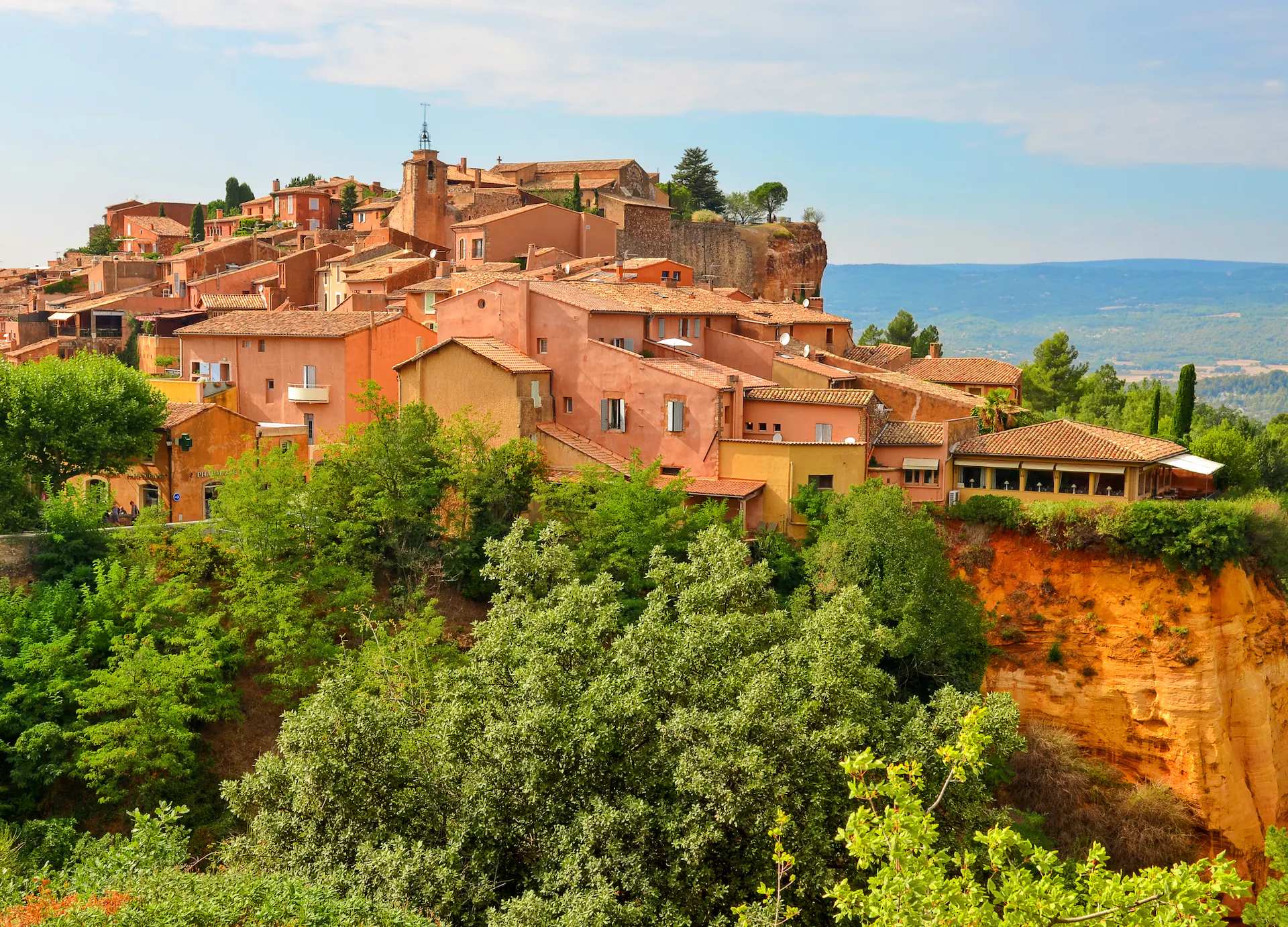
Gordes gets the postcard, but Roussillon earns the detour — the entire village is built from ochre-colored stone, and the Sentier des Ocres walking trail through the old mine pits looks color-graded by someone with an aggressive filter, except it’s real. Ménerbes and Lourmarin move slower still: no bus tours, no gift-shop density, just shuttered stone houses and a Tuesday market. Skip at least one “must-see” village on purpose. That’s not a loss. That’s the point of coming here.
The point of a trip like this was never the itinerary. It’s what a long lunch under a plane tree does to a person who hasn’t sat still in a year. Villa La Coste’s art walk, technically, is six hundred acres of contemporary sculpture on a working vineyard. What it actually gives you is permission to look at nothing else for three hours. That’s worth more than the art.
Who This Is For — and Who Should Book the Riviera Instead
Provence is for people who want their luxury quiet: long dinners, art you have to walk to find, a village square instead of a beach club. It’s for couples who’d rather split a bottle of rosé at golden hour than be seen doing it.
It is not for anyone chasing nightlife, yacht culture, or a beach. That’s the Côte d’Azur, an hour and a world away, and there’s no shame in wanting that instead. Provence asks you to slow down on purpose. If that sounds like a chore rather than a relief, this isn’t your trip.
Pull over for Gordes. Then keep driving. The villages that don’t make the guidebook covers are why you came.
FAQs
What is the best time to visit Provence for lavender season? Lavender typically blooms from late June through late July, with peak color in the final days of June and first week of July, particularly around Sénanque Abbey and the Valensole plateau.
How many days do you need in Provence? Five to seven days lets you split time between a Luberon base, like Gordes or Ménerbes, and a second stay near Aix-en-Provence, without rushing the drive between villages.
What is the best luxury hotel in Provence? Villa La Coste and Baumanière consistently rank as the region’s top properties, though Airelles Gordes La Bastide and Crillon le Brave are strong choices for a quieter stay.
Is Provence expensive to visit? Luxury hotels in Provence run comparable to five-star properties on the French Riviera, though dining and market shopping are noticeably less expensive than the coast.
How do you get to Provence from Paris? The TGV from Paris Gare de Lyon reaches Avignon in under three hours; flying into Marseille Provence Airport is the alternative for travelers heading further south.
Is Provence good for a honeymoon? Yes — the region’s smaller estates and villa-style hotels suit couples who want privacy over resort amenities, though travelers wanting a beach should consider pairing Provence with a few days on the coast.
What’s the difference between Provence and the French Riviera? Provence is inland, agricultural, and quiet, built around villages, vineyards, and lavender fields; the Riviera is coastal, social, and built around the beach club and yacht scene.
Related Reading
- A Luxury Travel Guide to the Amalfi Coast (luxury-amalfi-coast-travel-guide)
- A Luxury Travel Guide to Puglia (puglia-luxury-travel-guide)
- A Luxury Travel Guide to Uzbekistan (luxury-uzbekistan-travel-guide)