The cable car stops at eight in winter. That single fact decides more Taormina holidays than any hotel review, and almost nobody tells you before you book. Stay down at Mazzarò between November and March and your evening becomes a taxi negotiation on a hairpin road. Stay up in the old town in August and the beach is a fifteen-minute descent and a queue. The town is built on a cliff. Everything follows from that.
Where to stay in Taormina comes down to a straight choice between the clifftop old town and the bay at Mazzarò, and the right answer changes with the season. This guide covers both, plus Isola Bella and Giardini Naxos, with the cable car timetable, real journey times, and the hotels worth booking in each.
September and October are Taormina’s best months, and the UK booking window for them is open now. So this is a practical guide rather than a scenic one.
The short answer
First visit, any season: the old town. You came for Taormina, not for a beach that Sicily does better elsewhere.
Swimming is the priority, and it is summer: Mazzarò or Isola Bella.
Travelling between November and March: the old town, without hesitation, because of the cable car hours.
Value, or a family needing space: Giardini Naxos, with the trade-off stated honestly below.
The geography, and the cable car that governs everything
Taormina sits roughly 200 metres above the Ionian Sea on a terrace of Monte Tauro. The beaches are at sea level. The two are connected by a road of switchbacks and by the funivia, the cable car, and in practice everybody uses the cable car.
The station is on Via Luigi Pirandello, about 200 metres from the bottom of Corso Umberto. Published times and fares are as follows.
Summer hours: 8:00am to 1:30am daily.
Winter hours: 8:00am to 8:00pm daily.
Frequency: every 15 minutes, with capacity for around 680 passengers an hour.
Fares: €8 one way, €15 return, €20 for a day pass, €85 for a week.
Read those hours again, because they are the single most consequential thing on this page. In summer the cable car runs until half past one in the morning, which means staying at the beach and dining up in town is entirely workable. In winter it stops at eight, which means it stops before dinner.
The queue is the other consideration. In August the cable car is at capacity and a fifteen-minute wait at each end is normal. That is not a disaster. It is just twenty-five minutes each way that nobody budgeted for.
The old town
Corso Umberto, the Teatro Antico, the Piazza IX Aprile and the views that put Taormina on postcards for two centuries. This is what you came for, and for most travellers it is the correct choice.
What it gives you
You walk everywhere. Dinner is a stroll, not a logistics exercise. The Greek theatre is at the top of the town with Etna behind it, and in the evening after the day-trippers have gone the whole place changes character. Taormina empties around seven and refills with people staying there, which is a genuinely different town.
San Domenico Palace, and what we found
San Domenico Palace, Taormina, a Four Seasons Hotel is the property that defines the town, and at 9.7 it is the highest score we have awarded to any hotel we have reviewed anywhere.
It occupies a fourteenth-century Dominican convent on the clifftop, with the cloister still intact and terraced gardens dropping towards the sea. Our reviewer’s summary was that centuries of Sicilian history, the Ionian views, Michelin-starred dining and Four Seasons service come together in a way very few hotels manage.
It is also expensive, and it became considerably more so after the second series of The White Lotus was filmed there. If you are booking on the strength of the television programme, book early and expect the rate to reflect it.
The caveat on the old town
You are not on a beach and you cannot pretend otherwise. Getting into the sea means the cable car or a car, every single time. If your holiday is fundamentally a beach holiday, the old town will frustrate you by day three.
Mazzarò and the bay
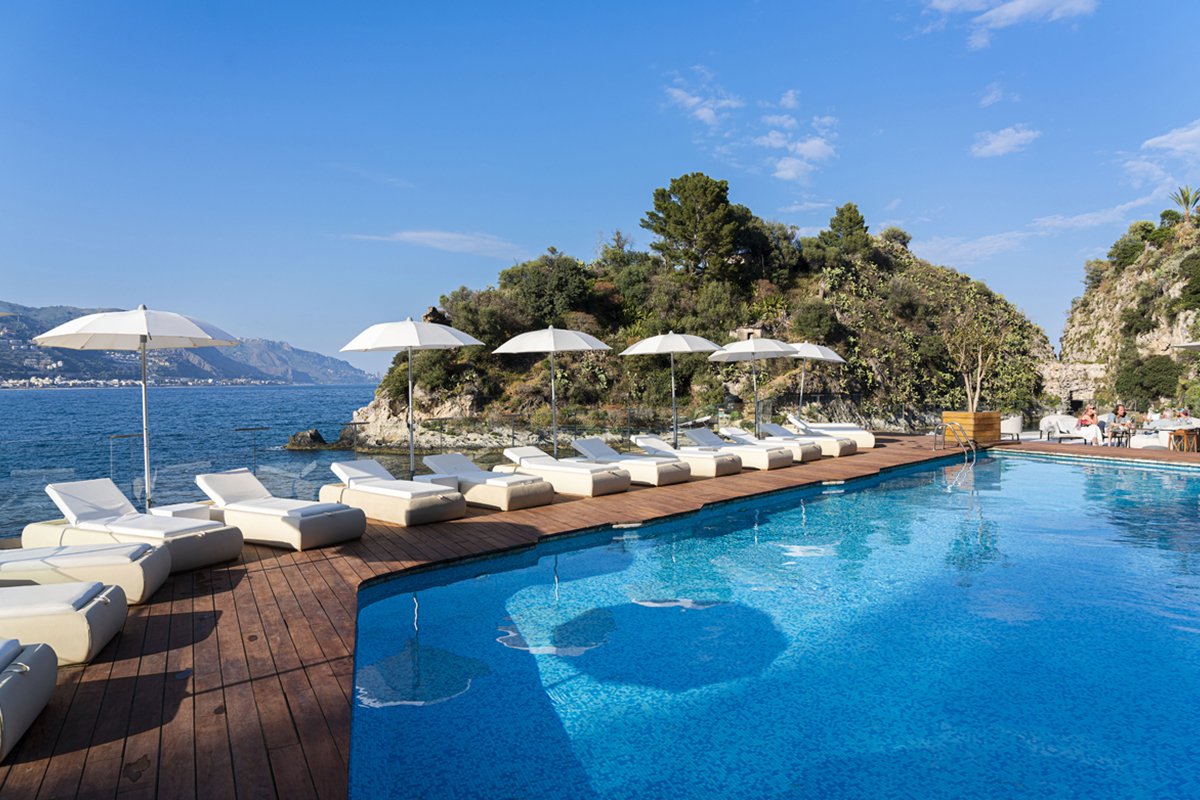
At sea level directly below the town, Mazzarò is where the swimming is. Small pebble coves, clear water and a cluster of hotels along the shore.
What it gives you
You walk out of the hotel into the sea. In July and August that is worth a great deal, and the cable car running to 1:30am means the old town is still available for dinner without a taxi.
The caveat
Winter, again. When the funivia closes at eight, Mazzarò becomes isolated after dark. The road up is a series of hairpins, taxis are finite and the fare is not trivial. For a September or October trip this still works, because the summer timetable runs to late March. For a November through February trip it does not.
The beaches are also pebble rather than sand, which surprises people expecting Caribbean conditions, and they are busy in high season.
Isola Bella
The small island nature reserve just south of Mazzarò, connected to the shore by a shingle spit that appears and disappears with the tide. It is the most photographed thing in Taormina after the theatre.
As a place to stay it functions much like Mazzarò, with the same cable car dependency, and the immediate area is more constrained. Stay here for the view from your room rather than for convenience.
Giardini Naxos
Five kilometres south along the coast, Giardini Naxos is a proper seaside town with a long sandy beach, considerably more accommodation and rates that are a fraction of Taormina’s.
The honest trade-off: it is not Taormina. It is a pleasant, ordinary Sicilian resort town from which you visit Taormina by bus or taxi, about fifteen to twenty minutes each way. For a family needing space and a real sandy beach, that is a rational exchange. For a couple on a four-night trip, it is a false economy, because you will spend the difference on taxis and lose the evenings.
When to go
September and October are Taormina’s best months and it is not close. The sea is still warm from the summer, the day-tripper volume collapses after the last week of August, the light is better and the rates fall.
April, May and early June are the other window, with cooler water and the town at its greenest.
July and August are hot, extremely busy and the most expensive. If those are your dates, the case for staying at Mazzarò strengthens considerably, because you will want the sea in the afternoons.
November to March is the quiet season. Some hotels close, the cable car goes to winter hours, and the town is genuinely lovely and genuinely sleepy. Stay in the old town or do not come.
Getting there and getting around
Catania Fontanarossa is the airport, roughly an hour by road with direct UK services through the summer season. Palermo is on the other side of the island and is the wrong airport for Taormina.
Do you need a car? For Taormina itself, no, and it is arguably a liability. The old town is largely pedestrianised, hotel parking is expensive and the approach roads are tight. Hire a car only if you are touring Sicily more widely, and consider collecting it on the day you leave Taormina rather than at the airport on arrival.
Etna is about an hour and a half away and is the single best day trip from the town. Castelmola, the village above Taormina, is a twenty-minute drive or a stiff walk. Savoca, where parts of The Godfather were filmed, is around forty minutes. Siracusa and Ortigia make a long but worthwhile day.
Our recommendation, by trip
First visit, couple, three or four nights: old town. Book San Domenico Palace if the budget allows and treat the beach as an excursion.
Beach holiday, July or August: Mazzarò, and use the late cable car for dinner in town.
Family, week or more: Giardini Naxos for space and sand, and accept the commute.
Autumn or winter trip: old town, non-negotiable, because of the funivia hours.
For the wider region, see our Taormina destination page, the Sicily guide and our Italy hub. If you are weighing Sicily against the mainland, our Amalfi Coast guide and Puglia guide cover the two obvious alternatives, and our guide to the best time to visit Sardinia covers the other island. For the brand, our Four Seasons hub collects every property we have reviewed, including the newly reopened Danieli in Venice.
Frequently Asked Questions
Should I stay in Taormina town or by the sea? The old town for a first visit and for any trip between November and March, because the cable car closes at 8pm in winter. Mazzarò or Isola Bella if swimming is the priority and you are travelling in summer, when the cable car runs to 1:30am.
Do you need a car in Taormina? No, and it is often a hindrance. The old town is largely pedestrianised, parking is expensive and the roads are tight. Hire a car only for touring the rest of Sicily.
How much is the Taormina cable car? €8 one way, €15 return, €20 for a day pass and €85 for a week. It runs every 15 minutes between Via Luigi Pirandello in the town and Mazzarò.
What time does the Taormina cable car stop? 1:30am in summer and 8:00pm in winter, starting at 8:00am in both seasons. The winter closing time is the single most important logistical fact when choosing where to stay.
Which Taormina hotels have views of Etna? Clifftop properties in the old town facing south and west get the Etna outlook, including San Domenico Palace, which we scored 9.7. Hotels at sea level in Mazzarò generally do not.
Is Giardini Naxos worth staying in? For families wanting a sandy beach and more space at lower rates, yes. For a short couples trip, no, because you lose the evenings in Taormina and spend the saving on taxis.
Where was The White Lotus filmed in Taormina? The second series was filmed largely at San Domenico Palace, the fourteenth-century convent hotel in the old town. Rates and demand rose noticeably afterwards, so book well ahead.
When is the best time to visit Taormina? September and October. The sea is still warm, the day-tripper crowds fall away after August, the light improves and rates drop. April to early June is the other good window.