

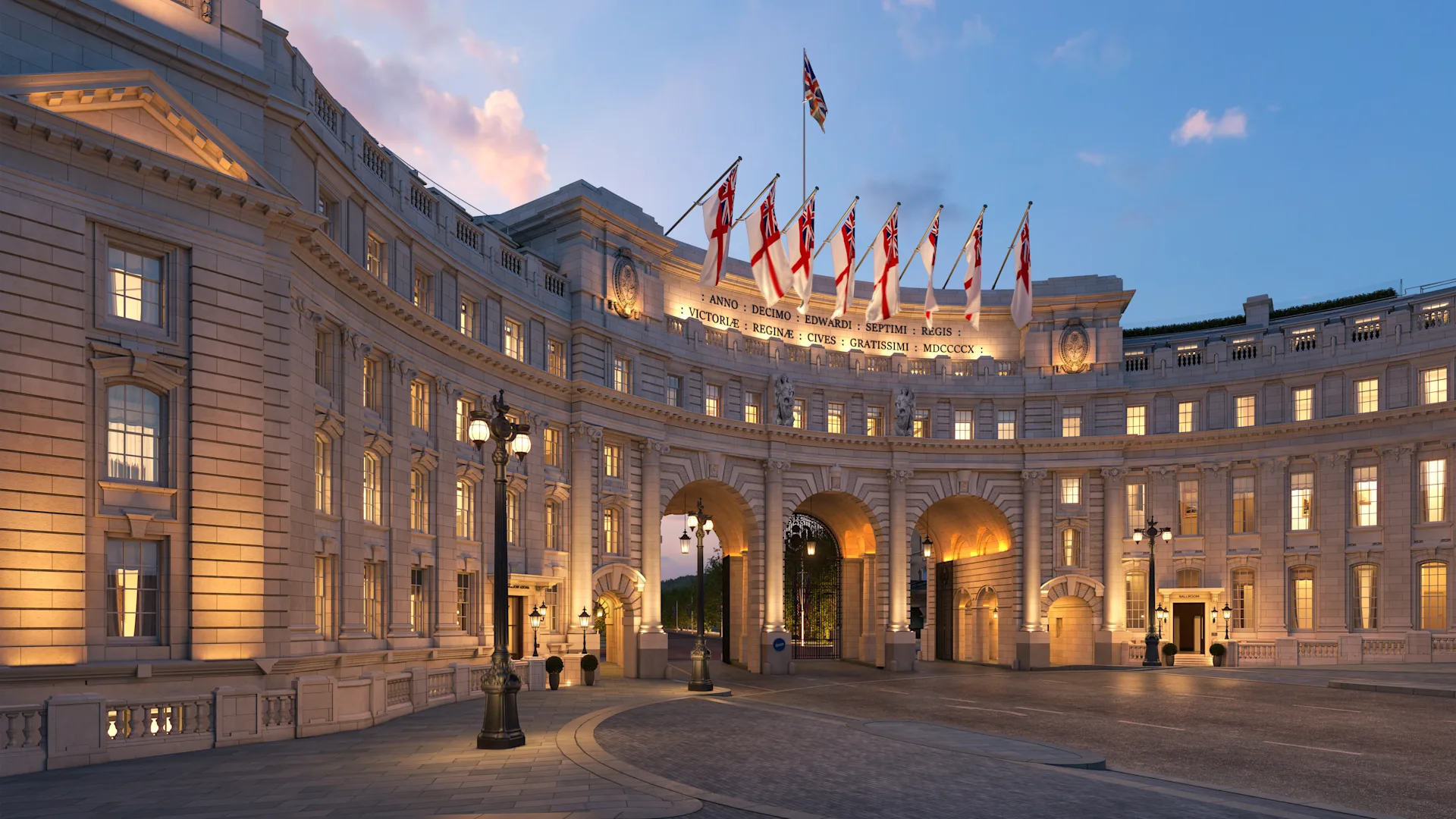
Every visitor to London has passed under it. Almost nobody has been inside. Admiralty Arch has stood at the top of The Mall since 1912, three great arches framing the ceremonial route between Trafalgar Square and Buckingham Palace, and for most of that time it has been a working government building rather than a place you could walk into. That changes this autumn. The Waldorf Astoria London Admiralty Arch will open inside one of the most photographed structures in the country, and after fourteen years of planning applications, ownership changes and quiet delays, the doors are finally close to opening.
We have gathered everything confirmed so far about the Waldorf Astoria London Admiralty Arch: the opening timeline, the 114 rooms and residences, the two restaurants from Clare Smyth and Daniel Boulud, the spa, the ballroom, what a night is likely to cost in cash or Hilton Honors points, and how it is likely to sit against the rest of London’s luxury market. Where a detail is unconfirmed, we say so.
The building, and why it matters
Admiralty Arch was commissioned by King Edward VII as a memorial to his mother, Queen Victoria, and designed by Sir Aston Webb, the architect responsible for the Buckingham Palace façade. It was completed in 1912 and served as the Admiralty Offices of the Royal Navy, including the residence of the First Sea Lord. Winston Churchill kept an office within the arch. Ian Fleming worked in the building during his naval intelligence years, which is a piece of trivia the marketing department will not be leaving alone.
The structure is Grade I listed, the highest level of protection in the English heritage system. That listing has shaped everything about the conversion. Windows, stonework, staircases and interior mouldings have all been restored rather than replaced, and the building’s ceremonial geometry has been kept intact. The result is a hotel of roughly 200,000 square feet that reads from the outside exactly as it always has.
Position is the other half of the story. The hotel sits at The Mall, SW1A, with Buckingham Palace in one direction and Nelson’s Column and Trafalgar Square in the other. No other London hotel has that. The Ritz has Green Park, the Savoy has the river, and Raffles has the Old War Office, but none of them sits on the processional route itself.
A fourteen-year restoration
The route here has been slow. Plans to convert the arch into a hotel emerged in 2012 under a 250-year lease. Waldorf Astoria was confirmed as the operator in 2017. Ownership passed to the Reuben Brothers, and the restoration ran on through a period when several London luxury openings slipped by years.
Anyone tracking the project has watched the opening date move from 2022 to 2024 to 2026. That history matters when you are deciding whether to book, and we return to it below.
When the Waldorf Astoria London Admiralty Arch opens
Hilton has stated an autumn 2026 debut. Reservations opened in June 2026, but only for stays from 1 March 2027 onwards, with the company saying earlier availability will be released as the hotel nears its opening. You can read the announcement in full on the Hilton newsroom.
That gap between the stated opening and the first bookable night is worth reading properly. It is not evidence of a problem. It is a hotel group protecting itself against the thing that goes wrong most often in this industry, which is a soft opening that arrives later than the press release promised.
Booking a landmark restoration for its first weekend is always a gamble. Our advice is the same as it was for the other big London conversions: let the hotel find its feet for a month or two, then go.
The rooms and residences
The hotel will hold 114 rooms, suites and residences. That figure has moved over the years, and earlier briefings referred to 100 keys plus separate residences, so the current number appears to fold both into a single count. Roughly half the building is given over to the residences and signature suites, which tells you a great deal about the commercial logic of the project.
The room that will define the hotel sits in the bridge of the arch itself, on the fourth floor: a two-bedroom suite looking straight down The Mall to Buckingham Palace. There is nothing else like it in London. Rooms elsewhere in the building look over St James’s Park on one side and Trafalgar Square on the other, and the mansard rooms in the roofline have the sort of proportions that only an Edwardian government building produces.
Expect a house style closer to the restrained, residential end of the Waldorf Astoria range than to the maximalism of the rebuilt Waldorf Astoria New York. The listing constraints more or less demand it. If you want a sense of how the brand handles heritage buildings in the UK, our review of The Caledonian Edinburgh is the closest existing comparison, and Rome Cavalieri shows what the brand does when it inherits a landmark rather than builds one.
Dining: Coreus, Cafe Boulud and a rooftop
The food and drink offer is the strongest part of the announcement, and it is the reason the hotel will matter to Londoners as well as to guests.
Clare Smyth MBE opens Coreus, a fine dining restaurant set within the former home of the First Sea Lord. The concept centres on the coastal produce of the United Kingdom, with sustainably sourced seafood and seasonal British ingredients. Smyth also opens a bar, Whiskey and Seaweed, built around a collection of British whiskies. Given what Core has achieved in Notting Hill, Coreus arrives with more anticipation than any London hotel restaurant in years.
Daniel Boulud returns to London with Cafe Boulud on the rooftop, an all-day format running from breakfast through afternoon tea to dinner, with terraces looking across St James’s Park and towards Buckingham Palace. Between them the two chefs hold a substantial haul of Michelin stars, and Cafe Boulud is the venue most likely to become the hardest table in the city next summer.
The ballroom runs to around 3,540 square feet and seats up to 320, with a restored Murano chandelier as its centrepiece. It is aimed squarely at the London event market, where the arch’s address does most of the selling on its own.
The spa and wellness floor
The spa has been designed as a deliberate counterpoint to the grand public rooms: discreet, self-contained and small. It holds individual and couples’ treatment rooms, a sauna, a steam room and a hydrotherapy pool, with a private relaxation area and a fitness facility alongside.
Nobody should book this hotel for the spa. A Grade I listed monument does not give you the square footage of a purpose-built resort, and a hydrotherapy pool is not a lap pool. If a serious hotel spa is what you are after in the UK, Fairmont Windsor Park remains the most complete operation within reach of London, and the wider Wellness and Spa collection covers the rest.
What it will cost
Opening rates for the first bookable dates have appeared from around £660 per night for an entry-level room, which is roughly 870 US dollars at current rates. For a Grade I listed landmark opposite Buckingham Palace, that is less than many people expected, and it undercuts several established London five stars in peak season.
Award pricing is more variable. Reported Hilton Honors rates for early dates have ranged from roughly 95,000 points per night on quieter dates up to 160,000 points on higher-demand ones, and some summer 2027 cash rates have appeared far above the opening figures. Hilton Honors uses dynamic award pricing, so there is no fixed standard rate to target and no published cap.
Three practical points follow.
- Book speculatively. With 114 keys and a global profile, award availability at the lower end will be thin. Hilton’s standard rates are refundable well in advance, so hold a date and decide later.
- Free night certificates are worth more here than almost anywhere. Unlimited-value certificates deliver their maximum return at exactly this kind of property.
- Compare total stay cost, not the rate. Breakfast for two in central London is a meaningful line item, and Hilton’s luxury agent programme can attach it along with a credit and an upgrade at the same nightly price.
Our Points and Miles hub covers how Honors compares with the other luxury programmes on exactly this kind of redemption.
How it fits into London’s luxury market
London has absorbed a remarkable amount of new luxury supply in a short period. Raffles arrived at the Old War Office, the Peninsula opened on Hyde Park Corner, the Emory brought an all-suite model to Knightsbridge, and the Park Hyatt London River Thames opened downriver. The Waldorf Astoria enters a market that is no longer short of options at the top.
What it has that the others do not is the address and the building. St James’s has never had a hotel in this position, and no amount of money buys a second Admiralty Arch. That should sustain a rate premium on the good rooms, particularly the arch-facing suites, even if the standard rooms sit in line with the market.
The competitive question is service. Waldorf Astoria is a strong brand but a broad one, spanning 16 properties in our own review set, from the excellent to the merely comfortable. London will be judged against the Connaught and Claridge’s, which have had a century to get it right. The opening team matters more than the renderings.
At the price point, the honest comparison set for a first-time visitor also includes hotels that are not in the same conversation architecturally but are considerably easier to book. The Dorian in Fitzrovia delivers a characterful stay for a similar nightly rate, and at the value end Hilton London Kensington exists for travellers who would rather spend the difference on dinner. Everything we have published in the city sits on the London destination page.
The neighbourhood, which is not a neighbourhood
One honest observation about the location. St James’s and Whitehall are magnificent and largely institutional. This is the district of government offices, gentlemen’s clubs and royal parks, and it empties in the evening in a way that Mayfair and Covent Garden do not.
That cuts both ways. You are five minutes from the National Gallery, ten from Covent Garden, twelve from the theatres of Shaftesbury Avenue and a short walk across St James’s Park to Westminster. Almost every ceremonial event in the British calendar passes the front door, which is either the reason you booked or a warning about road closures, depending on your temperament.
What you do not get is a doorstep neighbourhood. There is no cluster of small restaurants outside, no local shopping street, and very little life on The Mall after dark beyond the hotel’s own rooms. Guests who like to wander out and find dinner will do more walking here than they would from a Mayfair base.
Transport is straightforward. Charing Cross is a four-minute walk, giving you the Northern and Bakerloo lines and mainline services, and Embankment adds the District and Circle. Heathrow is around fifty minutes by taxi or a Piccadilly line journey from Green Park, and the Elizabeth line at Tottenham Court Road is roughly ten minutes away by cab.
What we expect, and what we are watching
Three things will decide whether this hotel becomes a landmark or merely occupies one.
Service depth. A 114-key hotel in a listed building has awkward circulation, long corridors and no back-of-house shortcuts. Staffing it properly is expensive. Whether Hilton funds that level in year one is the single biggest variable.
Whether the restaurants stay great. Chef-branded hotel restaurants often open brilliantly and drift. Coreus and Cafe Boulud both have strong operators behind them, but London has seen this pattern before.
Whether the rate holds. An opening rate of £660 is deliberately soft. If the hotel delivers, expect that number to move quickly once the first reviews land, which is an argument for booking early rather than waiting.
How to decide whether to book it
A few honest filters before you commit to an opening-period stay.
- Book it if you collect Hilton Honors points. This is now the most compelling redemption in the programme’s European portfolio, and points insulate you from a rate that will rise once the reviews land.
- Book it if the building is the point. Staying inside a national monument is the product here. If that idea does not move you, the Connaught delivers better food, better service history and a quieter street.
- Wait if you want reliability. New openings have teething problems, and heritage conversions have more of them than most. A stay from spring 2027 onwards carries far less risk than the opening weeks.
- Pay up for the view. An entry-level room here is a nice room in a famous building. A room facing The Mall or Trafalgar Square is the experience people will talk about.
- Do not book it for a spa weekend. The wellness offer is competent and small. That is not what you are paying for.
- Book through a luxury agent programme. The nightly rate is identical, and the added breakfast, credit and upgrade are not.
Frequently asked questions
When does the Waldorf Astoria London Admiralty Arch open?
Hilton has confirmed an autumn 2026 opening. Reservations currently run from 1 March 2027, with earlier dates expected to be released closer to the debut. Opening dates for heritage conversions move often, so confirm before booking travel around it.
How many rooms does it have?
The hotel comprises 114 rooms, suites and residences across roughly 200,000 square feet, with residences and signature suites occupying around half the building.
Which restaurants are opening at Admiralty Arch?
Coreus by Clare Smyth, a seafood-led fine dining room in the former residence of the First Sea Lord, and Cafe Boulud from Daniel Boulud on the rooftop, serving all-day dining and afternoon tea. Clare Smyth also opens a whisky bar, Whiskey and Seaweed.
How much does a night cost?
Opening rates have appeared from around £660 per night for entry-level rooms. Hilton Honors award nights have been seen between roughly 95,000 and 160,000 points, depending on date and demand.
Is it worth booking during the opening period?
Only if the building itself is your reason for going. Heritage conversions rarely run smoothly in their first weeks, and a stay from spring 2027 will be a more reliable experience at a similar rate.
Can non-guests visit the restaurants?
The restaurants, bars and rooftop are expected to accept outside bookings, as is standard for Waldorf Astoria properties in city centres. The ballroom and event spaces are bookable for private hire.
Is Admiralty Arch a listed building?
Yes. It is Grade I listed, the highest level of protection in England, which is why the restoration has taken as long as it has and why the exterior is unchanged.
The verdict, before anyone has stayed
The Waldorf Astoria London Admiralty Arch is the most significant London hotel opening in years. It has a building nobody can replicate, two of the most credible chefs working in the city, and an opening rate more reasonable than the address suggests.
What it has not yet proved is that it can operate at the level its neighbours do. Waldorf Astoria has produced outstanding hotels and thoroughly ordinary ones. London will not be forgiving about which of those it gets. We will review it in full once it opens, scored against the same scale as every other property on this site, and until then the sensible position is enthusiasm with a booking made for 2027 rather than 2026.
For more, see our Waldorf Astoria brand page, which now covers 16 reviewed properties, the wider United Kingdom hub, and How We Review if you want to know how we score. Official rates and reservations are on the hotel’s own site.