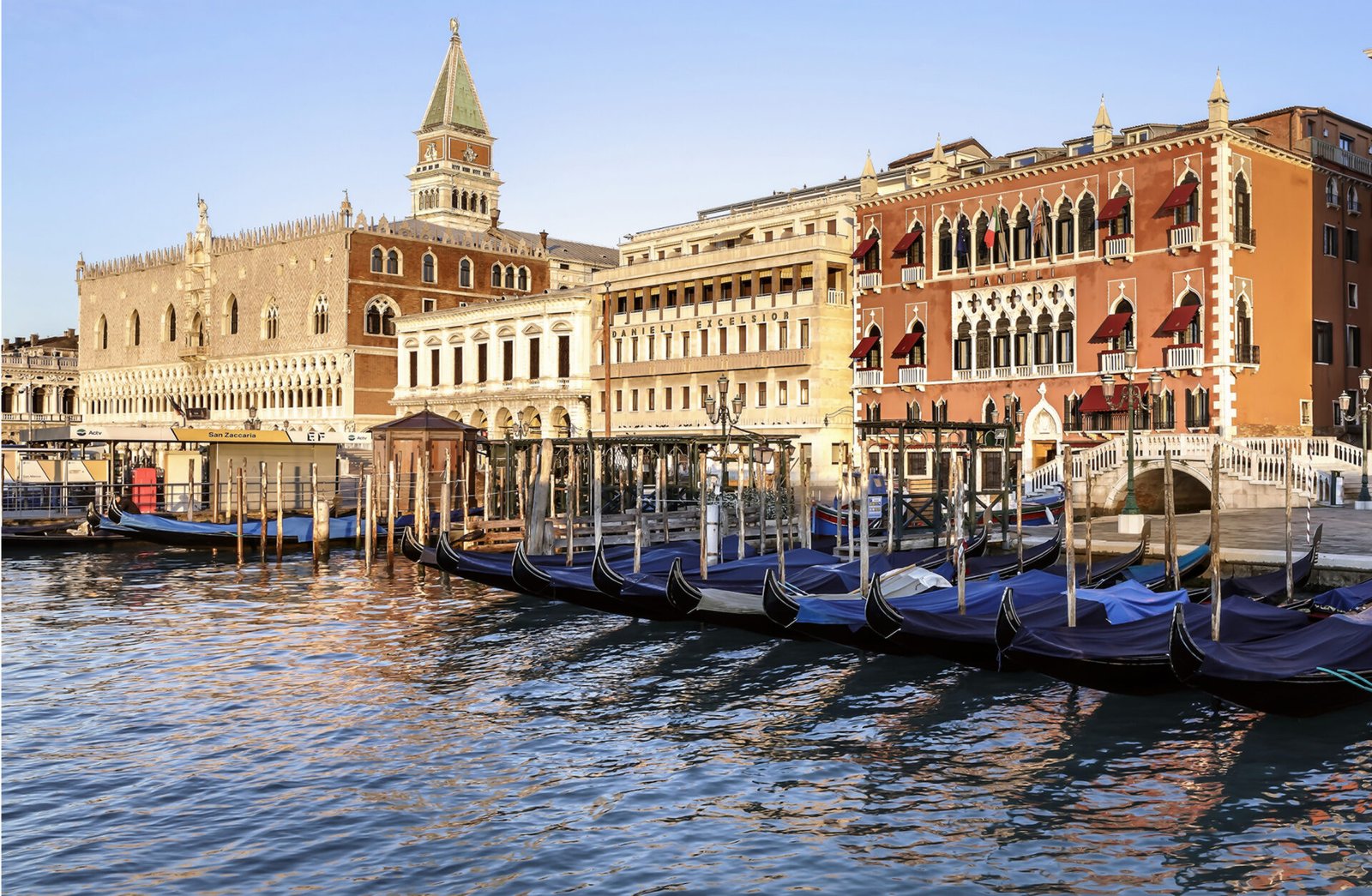
The Danieli closed in 2022 with the shutters down and a hoarding across the Riva degli Schiavoni, and for four years the most photographed hotel facade in Venice was a building site. Vaporetti went past it every eleven minutes. Nobody got off. What reopened at the end of July 2026 is the same address, the same fifteenth-century staircase, and an almost entirely different hotel behind it. That is the interesting part. Not that Four Seasons took it on, but what they decided to leave alone.
The Danieli Four Seasons Venice opened on 30 July 2026 after a four-year restoration by Pierre-Yves Rochon, bringing 120 rooms and suites, a rooftop restaurant under Adriano Rausa and a spa arriving later this year. Here is what has actually changed, what it costs, and how it now compares to the hotel that has owned the top of the Venice market for the past decade.
Venice does not get many new hotels. The city has roughly the same building stock it had in 1800, and every conversion is a negotiation with the Soprintendenza before it is a design brief. So when a property with this much history changes hands and reopens under a brand this exacting, it resets the ranking. Here is what we know so far.
What actually happened, and when
Four Seasons announced in January 2026 that guest arrivals would begin on 26 August. In the event, the hotel opened almost a month early. The Four Seasons press room published its “Now Open” release on 30 July 2026, and Euronews confirmed the reopening the following day.
Worth knowing if you booked on the earlier announcement: the August date circulated widely in the trade press for six months and some third-party sites are still carrying it. Check your confirmation against the hotel directly rather than an aggregator.
Three buildings, not one
The Danieli has always been three palazzi pretending to be a single hotel, which is why the floor plan has never quite made sense to anyone walking it for the first time.
Palazzo Dandolo is the one in the photographs. Built in 1471 as a residence for the Dandolo family, it is one of the better surviving examples of Venetian Gothic domestic architecture in the city, and it has operated as a hotel since 1822. Charles Dickens stayed. So did Richard Wagner.
Palazzo Casa Nuova once housed the Treasury of the Venetian Republic, which tells you something about the address.
Palazzo Danieli Excelsior is still closed. Its restoration completes in 2027, and it carries the remaining keys.
The restoration, and what Rochon chose not to touch
Pierre-Yves Rochon led the interiors. He is a safe pair of hands for a building like this, with a record of restoring grand European hotels without flattening them into generic international luxury, and the brief here was clearly conservation first.
The palette is drawn from the lagoon rather than from a Venetian cliche: celadon green, soft blues, terracotta, ochre and powder pink. Murano glass, terrazzo flooring and bespoke Rubelli textiles run through the public rooms. The lobby ceiling has been hand-painted and gilded in a quatrefoil pattern. None of that is new to the building. Most of it is a careful reinstatement of what was there.
What is genuinely new is the technology, and it has been buried. Automated curtains, customisable lighting and a media wall are integrated so they do not read as a control panel bolted to a fifteenth-century wall, which is the failure mode of most historic hotel refits.
The rooms
There are 120 rooms and suites open now, rising to 168 when Palazzo Danieli Excelsior comes back in 2027. Junior Suites and One-Bedroom Suites have been enlarged, and there are more connecting configurations than before, which matters more than it sounds. Historic Venetian hotels are notoriously bad for families, because the room shapes are inherited rather than designed.
The honest caveat on the entry-level rooms: this is a converted palazzo, and the smallest categories are small. If the view is the reason you are coming, book up. The gap between a room facing the lagoon and a room facing a calle is the single biggest variable in the whole property, and it is larger here than at most hotels in this bracket.
What is new that was never here before
Terrazza Danieli
The rooftop restaurant is under Executive Chef Adriano Rausa, cooking contemporary Italian with Venetian influence and finishing signature dishes at the table. The terrace looks across to San Giorgio Maggiore, which is the view most people picture when they picture Venice from above, and the aperitivo programme at the adjoining bar leans on reinterpreted classics rather than novelty.
The rooftop was always the Danieli’s best asset and it was always underused. Turning it into the culinary centre of the hotel is the most obviously correct decision in the entire project.
Danieli Spa
Arriving late 2026, with three treatment rooms including a couples’ suite, plus a sauna and hammam. Modest by resort standards, which is normal for a Venetian palazzo where every square metre is contested, but the Danieli previously had no spa at all.
If a spa is central to your trip, note that it is not open yet. Book after it opens, or plan around it.
What it costs
Published reporting puts winter rates from around $1,000 per night and summer rates from around $2,000, which places the Danieli at the top of the Venice market without being an outlier in it. For context, the city’s other trophy properties occupy roughly the same band in high season, and the differentiator is not price. It is which version of Venice you want to wake up in.
The Riva degli Schiavoni is two minutes from Piazza San Marco. That is the Danieli’s greatest strength and its most significant compromise, and both are worth understanding before you book.
Is it the best hotel in Venice now?
Not automatically, and the honest answer depends on what you want from the city.
Our review of Aman Venice, which we scored 9.6, still stands as the reference point at this level. Aman occupies Palazzo Papadopoli in San Polo, on the Grand Canal near the Rialto, with original Tiepolo frescoes, gilded ballrooms and two private gardens in a city where green space barely exists. It holds just 24 rooms in a building that could take far more, and that restraint is the entire proposition. It is quiet in a way a hotel two minutes from San Marco structurally cannot be.
That number is worth sitting with. The Danieli opens with 120 keys and goes to 168. Aman has 24. Whatever else separates these two hotels, that ratio explains most of it.
The Danieli’s case is different and, for a first visit, arguably stronger. You are inside the historic centre rather than adjacent to it. You can walk out at seven in the morning, before the day-trippers land, and have the piazza to yourself. The building itself is a reason to stay rather than a container for the stay. And the rooftop is now a genuine destination rather than a bar you visit once.
Here is the contrarian read. The Danieli’s location has been described as a drawback by people who prefer their Venice hushed. For most travellers it is the opposite. The whole point of paying this much is proximity, and Aman’s Grand Canal address, for all its beauty, involves a boat or a walk every time you want to be anywhere. Choose the Danieli if you intend to actually use Venice. Choose Aman if you intend to retreat from it.
Further down the market, our reviews of the Radisson Collection Palazzo Nani in Cannaregio and the Hilton Molino Stucky on Giudecca, scored 8.6, cover the two most credible alternatives at materially lower rates. The Molino Stucky also has what our reviewer called the only rooftop swimming pool in Venice, seasonal and compact, but genuinely unmatched in a city where nobody else has one.
Should you book now or wait for 2027?
Two arguments for waiting. The spa is not open until late 2026. The Excelsior wing and its remaining keys arrive in 2027, and with them the full room inventory and whatever else has been held back.
Two arguments for going now. Opening-season Four Seasons properties tend to be over-staffed rather than under-staffed, which usually means better service than the same hotel delivers in year three. And a 120-key hotel is a quieter hotel than a 168-key one.
Our view: go now if you want the building and the service, and if the timing suits a shoulder-season trip. Wait until 2027 if the spa or a specific suite category is central to the plan. Either way, the autumn and winter months are the right time to see this hotel, for reasons we set out in our guide to how to spend 48 hours in Venice.
Where this sits in the Four Seasons portfolio
The Danieli is the group’s fourth Italian property, joining Florence, Milan and Taormina. Rainer Stampfer, Four Seasons President, framed the reopening as ushering in “a new chapter” for that portfolio, which is corporate language for an obvious strategic point: Four Seasons now holds a trophy address in three of the four Italian cities that matter most to luxury travellers.
If you want a sense of how the brand handles a historic Italian landmark before you commit, our review of San Domenico Palace, Taormina, a fourteenth-century convent converted with a similar degree of restraint, is the closest available comparison. The wider Four Seasons brand hub collects every property we have reviewed, and our Venice destination guide and Italy hub cover the rest of the market.
What we will be testing when we review it
We have not stayed yet. This is an assessment of the reopening, not a review, and we will not score the hotel until we have. When we do, these are the four things that will decide it.
Whether the entry-level rooms justify the entry-level rate. Palazzo conversions live or die on their worst category, not their best.
Whether the service holds at the Riva degli Schiavoni. A hotel this exposed to foot traffic has to protect its guests at the door without being unpleasant about it.
Whether Terrazza Danieli is a restaurant or a view. Rooftops in tourist cities have a habit of coasting.
Whether the technology stays invisible. It is invisible on opening week. Ask again in eighteen months.
Our full review methodology sets out how we score, and what we do not accept from hotels in exchange for coverage.
Frequently Asked Questions
When did the Danieli Four Seasons Venice open? The hotel opened on 30 July 2026, roughly four weeks ahead of the 26 August date announced by Four Seasons in January 2026. Some third-party listings still show the original date.
How many rooms does the Danieli have? 120 rooms and suites are open now. That rises to 168 in 2027, when the restoration of Palazzo Danieli Excelsior completes.
How much does a night at the Danieli cost? Published reporting puts winter rates from around $1,000 per night and summer rates from around $2,000, varying by category and season. Lagoon-facing rooms carry a significant premium over interior rooms.
Who designed the Danieli restoration? French interior designer Pierre-Yves Rochon, working with a lagoon-derived palette of celadon green, soft blue, terracotta, ochre and powder pink, alongside Murano glass, terrazzo flooring and bespoke Rubelli textiles.
Is the Danieli spa open? Not yet. Danieli Spa opens in late 2026 with three treatment rooms including a couples’ suite, plus a sauna and hammam. Check directly with the hotel before booking a stay built around it.
Is the Danieli better than Aman Venice? They answer different questions. The Danieli is inside the historic centre, two minutes from Piazza San Marco, and suits travellers who want to use the city. Aman Venice, on the Grand Canal, is quieter and more secluded. Read our Aman Venice review for the full comparison.
What is the restaurant at the Danieli? Terrazza Danieli, a rooftop restaurant under Executive Chef Adriano Rausa serving contemporary Italian with Venetian influence, with views across to San Giorgio Maggiore. Bar Dandolo handles the aperitivo programme.
How old is the Danieli? Palazzo Dandolo was built in 1471 as a residence for the Dandolo family. It has operated as a hotel since 1822 and has hosted guests including Charles Dickens and Richard Wagner.